Pennsylvania summer is rough on wood. The humidity sits in the 70s and 80s for weeks, the sun bakes the boards, then a thunderstorm rolls through and soaks everything in twenty minutes. Your deck takes a beating from May through September. If you don’t prep it now, you’ll be replacing boards or worse — the whole damn thing — a lot sooner than you think.
Here’s what to actually do. Not the watered-down version from a hardware store flyer. The real list.
Walk the deck. Then walk it again.
Before you touch a hose or a stain can, inspect every square foot. I mean it. Get a flashlight and a screwdriver and start poking.
Look for soft spots. Push the screwdriver into the boards near the posts, around the ledger (the board bolted to your house), and at the joist ends. If it sinks in like you’re poking a wet sponge, that wood is rotting. Pay extra attention to anywhere water sits — corners, under planters, the spot where leaves pile up every fall.
Check the fasteners. Popped nails and lifted screws aren’t cosmetic. They mean the boards are moving, and moving boards let water down into the structure. Drive them back in or pull them and replace with proper deck screws.
The ledger board is where most decks fail. I had a job in Manayunk a few years back where the homeowner called me out for “a little wobble.” I pulled the siding above the ledger and the entire band joist was black, soaked, and crumbling — no flashing had ever been installed in twenty years. That deck was inches from coming off the house with twelve people on it for a Memorial Day barbecue. Check your ledger. Look for rust streaks on the bolts. Look for any sign of water staining the siding above it. If you’re not sure what you’re looking at, pay somebody who does to give it a look. Cheaper than the alternative.
Clean it without destroying it.
People love their pressure washers. They also love to tear the hell out of their deck with them. Pressure washing wood at 3,000 PSI from six inches away will turn pressure-treated pine into fuzzy garbage that drinks up water like a sponge for the rest of its life. You’re not cleaning the deck at that point. You’re ruining it.
Here’s the right way:
- Sweep first. Get the debris out from between the boards. A putty knife works for the gunk that’s wedged in there.
- Use a real deck cleaner. The oxygenated stuff (sodium percarbonate) handles general grime, pollen, and surface mildew. Spray it on, let it sit per the directions, scrub with a stiff-bristle brush.
- For black mildew that’s set in deep, step up to a deck wash with bleach. Soak your plants with water first, cover anything you don’t want killed, and rinse hard when you’re done.
- If you use a pressure washer, use a wide fan tip, keep it under 1,500 PSI, and stay at least a foot off the wood. Go with the grain. Not across it.
When you’re done, the deck should look clean — not stripped down to raw splinters.
Let it dry. Actually dry.
This is where most homeowners screw it up. They clean Saturday morning, the sun comes out, they’re feeling productive, and they slap a coat of sealer on by Saturday afternoon. Three months later the finish is peeling in sheets and they can’t figure out why.
Wood needs time. After a cleaning, you want at least 48 hours of dry weather before you put anything on it. Hot, humid PA days mean the boards are holding moisture you can’t see by looking. Quick test: sprinkle water on the deck. If it beads up, the wood is still too wet or too slick — wait or sand it lightly. If it soaks in within a few seconds, you’re good.
Don’t seal in direct hot sun either. The finish flashes off the top before it can soak in, and you get a finish that sits on the surface instead of bonding. Early morning or late afternoon, on a day under 85 degrees, no rain in the forecast for 24 hours. That’s the window.
Pick the right sealer and put it on right.
Two real categories: penetrating oil-based finishes and water-based acrylics. Oil-based soaks in deeper and tends to wear by graying out rather than peeling — easier to recoat down the line. Water-based dries faster and a lot of the newer products have better UV protection, but when they fail they tend to peel and lift, which means a strip job before you can recoat.
For PA weather, I lean toward a penetrating semi-transparent stain with UV blockers and a mildewcide built in. It handles the humidity better and the next maintenance cycle is a clean-and-recoat instead of a strip-and-pray.
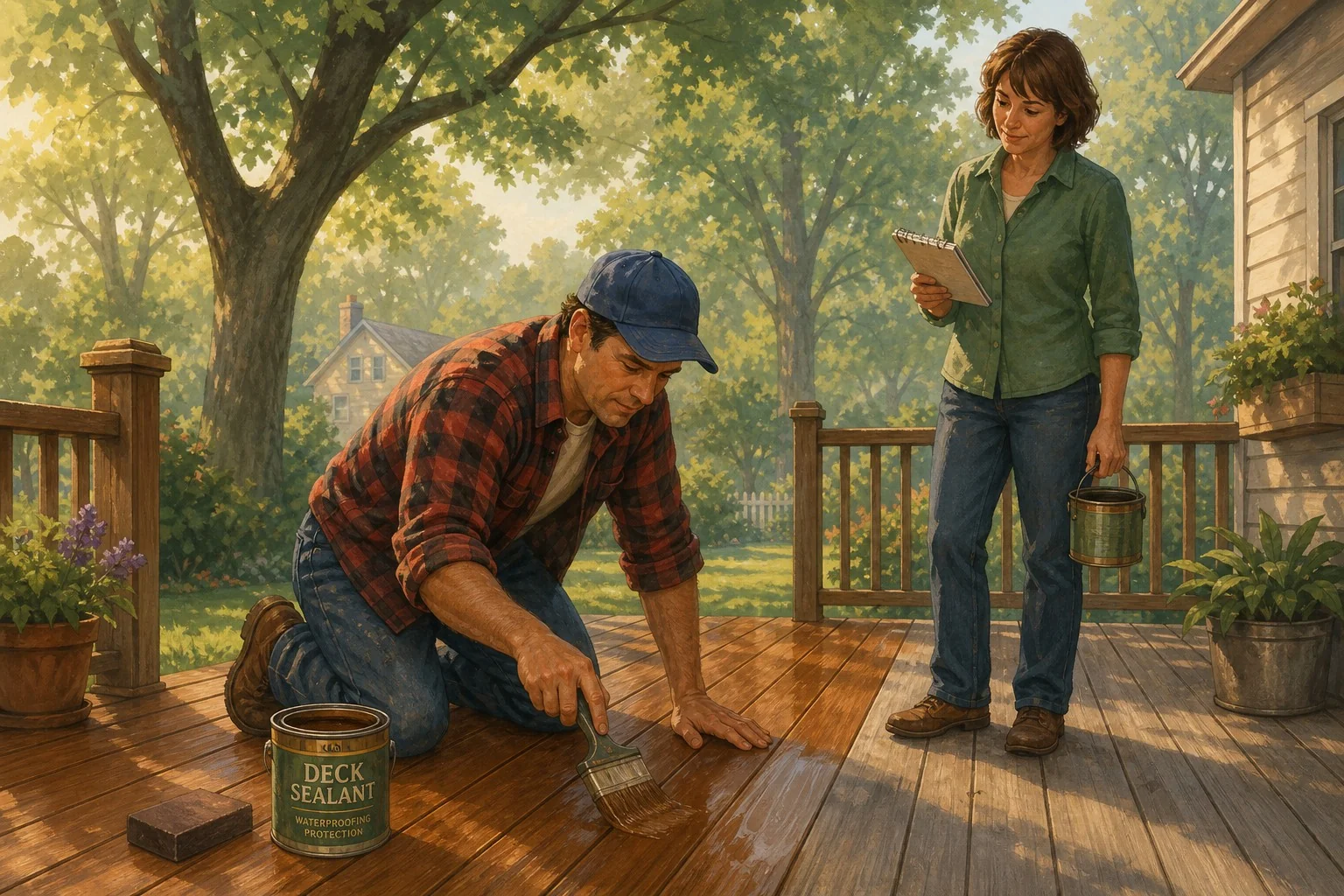
Apply with a stain pad or a brush. A roller is fine for the open field of the deck, but back-brush it into the grain so it actually penetrates. Two thin coats, not one heavy one. One heavy coat is how you end up with a sticky, blotchy finish that never fully cures.
Don’t forget the parts you can’t see from the chaise lounge.
Crawl under the deck if you can get under there. Check the joists for any white powdery deposits — that’s moisture working — or insect damage. Check the post bases. They should be sitting on concrete or a proper galvanized post base bracket. Wood touching dirt in PA humidity is a countdown clock to rot, and the clock isn’t long.
If your deck is more than ten or twelve years old and nobody has ever looked at the structural connections — the ledger bolts, the joist hangers, the post-to-beam fasteners — get that done this year. A deck collapse isn’t a “maybe it’ll be inconvenient” situation. It’s an emergency room situation, and the news loves running those stories every summer.
Bottom line
Prep your deck in the spring or early summer, before the worst of the humidity hits. Inspect it, clean it carefully, let it dry fully, seal it right. Skip steps and the deck will tell you about it — usually by failing in a way that costs you ten times what the prep would have.
A wood deck in this climate is a maintenance commitment. You signed up for it the day you bought the house with the deck on it. Take care of it and it’ll last you twenty, thirty years. Ignore it and you’ll be ripping it out in eight.