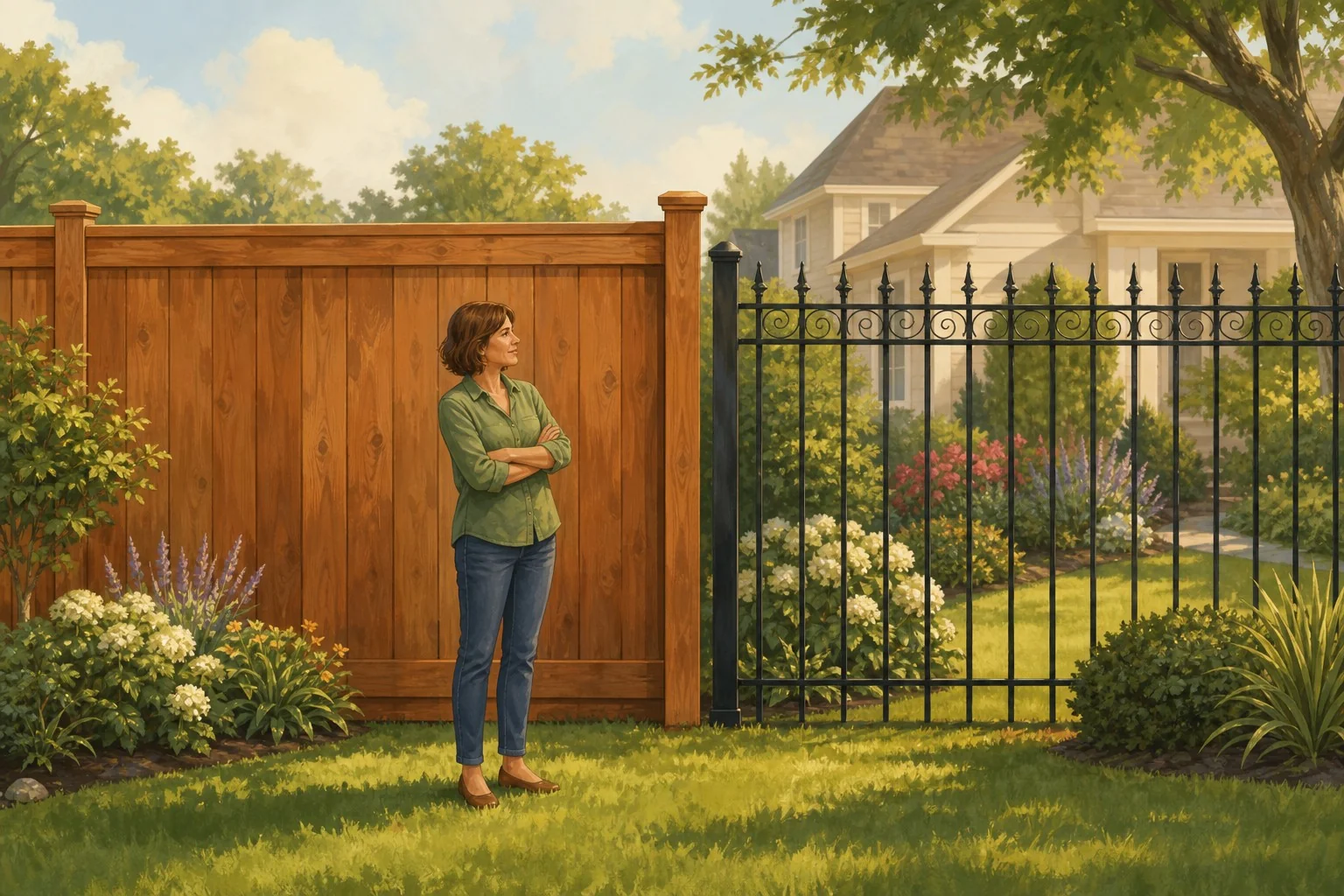
Homeowners ask me this all the time, usually after they’ve already argued about it with their spouse for a month. Here’s the thing — the answer isn’t about which fence looks better on Pinterest. It’s about what you actually need the fence to do.
Pick the wrong one and you’re either staring at your neighbor’s above-ground pool for the next fifteen years, or you spent double what you needed to and the yard still feels exposed. Neither one is a win.
Let me break it down the way I’d tell my brother-in-law.
What a Privacy Fence Actually Does
A privacy fence is a wall. That’s it. It blocks sightlines, dampens a little noise, and gives you a backyard where you can walk around in whatever you want without your neighbor waving from his lawnmower.
Standard height is six feet. In some townships you can push it to seven or eight if code allows, but six is the workhorse. Boards go tight — butted, board-on-board, or shadowbox. Cedar and pressure-treated pine are the usual suspects. Vinyl if you don’t want to stain anything for the next twenty years, but expect to pay more up front.
Get a privacy fence when:
- Your yard backs up to another house, an alley, or a busy street
- You’ve got a pool, a hot tub, or you actually use your backyard for something more than looking at it
- You have a dog that treats every passing pedestrian as a personal insult
- Your neighbor’s yard looks like a scrap metal yard and you’re tired of seeing it
Where privacy fences get people in trouble is maintenance. Wood fences move. They warp, they gray out, they eat stain like candy. Skip sealing them every couple of years and they turn into a science experiment. Don’t buy one thinking it’s set-it-and-forget-it.
What an Ornamental Fence Actually Does
Ornamental is a different animal. Wrought iron, aluminum, sometimes steel. The whole point is to define a boundary without walling anything off. You see through it. Your neighbors see through it. Everybody sees through it.
Ornamental is the right call when:
- You’ve got a nice front yard and you want to frame it, not hide it
- You need to keep kids or dogs in the yard but you don’t care who sees in
- Your HOA won’t let you put up a solid fence taller than four feet (more common than people think)
- You have a pool and code requires a fence, but you don’t want your backyard to feel like a bunker
Aluminum is the sweet spot for most homeowners. It doesn’t rust, it doesn’t need painting, and a decent panel system will last thirty-plus years. Real wrought iron is beautiful, but it’s heavy, expensive, and you’ll be scraping and painting it every few years to keep it looking right.
Here’s the part people don’t want to hear: ornamental doesn’t do a damn thing for privacy or noise. If those matter to you, ornamental is the wrong choice. Don’t talk yourself into it because it looks nicer in the catalog.
Zoning, HOA, and Permits — Don’t Skip This
Every township, borough, and city has fence rules. Height limits, setback requirements, corner-lot sightline restrictions, front-yard limits — the list goes on. HOAs pile their own rules on top, and those are usually stricter than the municipal ones.
I had a homeowner up in Roxborough call me in a panic a few years back. He’d already had a six-foot cedar privacy fence installed by some guy off Facebook, no permit, no HOA approval. The HOA sent him a letter three weeks later, and he ended up ripping the whole thing down and putting in a four-foot aluminum fence instead. He paid twice for one fence. Don’t be that guy.
Before you spend a dime:
- Call your township zoning office and ask what’s allowed
- If you’re in an HOA, get the rules in writing and their approval in writing
- Check your property survey and know where the actual property line is — not where you think it is
- If you’re on a corner lot, ask specifically about the sightline triangle at the intersection
Ten minutes on the phone can save you five grand and a lawsuit with your neighbor.
Security — The Honest Answer
Nobody wants to hear this, but here it is. Neither fence stops somebody who actually wants in. A six-foot privacy fence can actually help a burglar — once they’re over it, they’re hidden from the street. A four-foot ornamental fence keeps honest people honest and slows down opportunists, but that’s about it.
If security is the real concern, the fence isn’t your answer. Lighting, cameras, a real lock on the gate, and a dog do more than any fence ever will. Buy the fence for what it’s good at, and buy the security stuff separately.
The Money Talk
Ballpark, in my market: a decent six-foot pressure-treated privacy fence runs somewhere in the neighborhood of $30 to $50 a linear foot installed. Cedar bumps that up. Vinyl privacy runs higher still. Aluminum ornamental is usually in the $35 to $60 range, depending on the panel style and gate hardware. Custom wrought iron? That’s a whole other conversation, and if you have to ask, you probably don’t want the answer.
Prices move with lumber, aluminum, and labor, so treat those as ballpark, not gospel. Get three quotes. And if one bid is way cheaper than the other two, that’s not a deal — that’s a warning.
How to Actually Decide
Stand in your backyard. Look around. Answer three questions honestly:
- What am I trying to block — a view, a sound, a person, or a pet?
- What does the front of my house need to look like from the street?
- What will the township and the HOA actually let me build?
If privacy is the answer and the rules allow it, go privacy. If you want the yard to feel open and you just need a clean boundary, go ornamental. Some properties want both — privacy in the back, ornamental in the front — and there’s nothing wrong with that.
If you still can’t decide, walk your block and look at what your neighbors did. The ones with fences they still like after ten years usually got it right the first time. Ask them what they’d change.
Pick the fence for the job you actually need done. Not the one you saw on somebody’s Instagram.