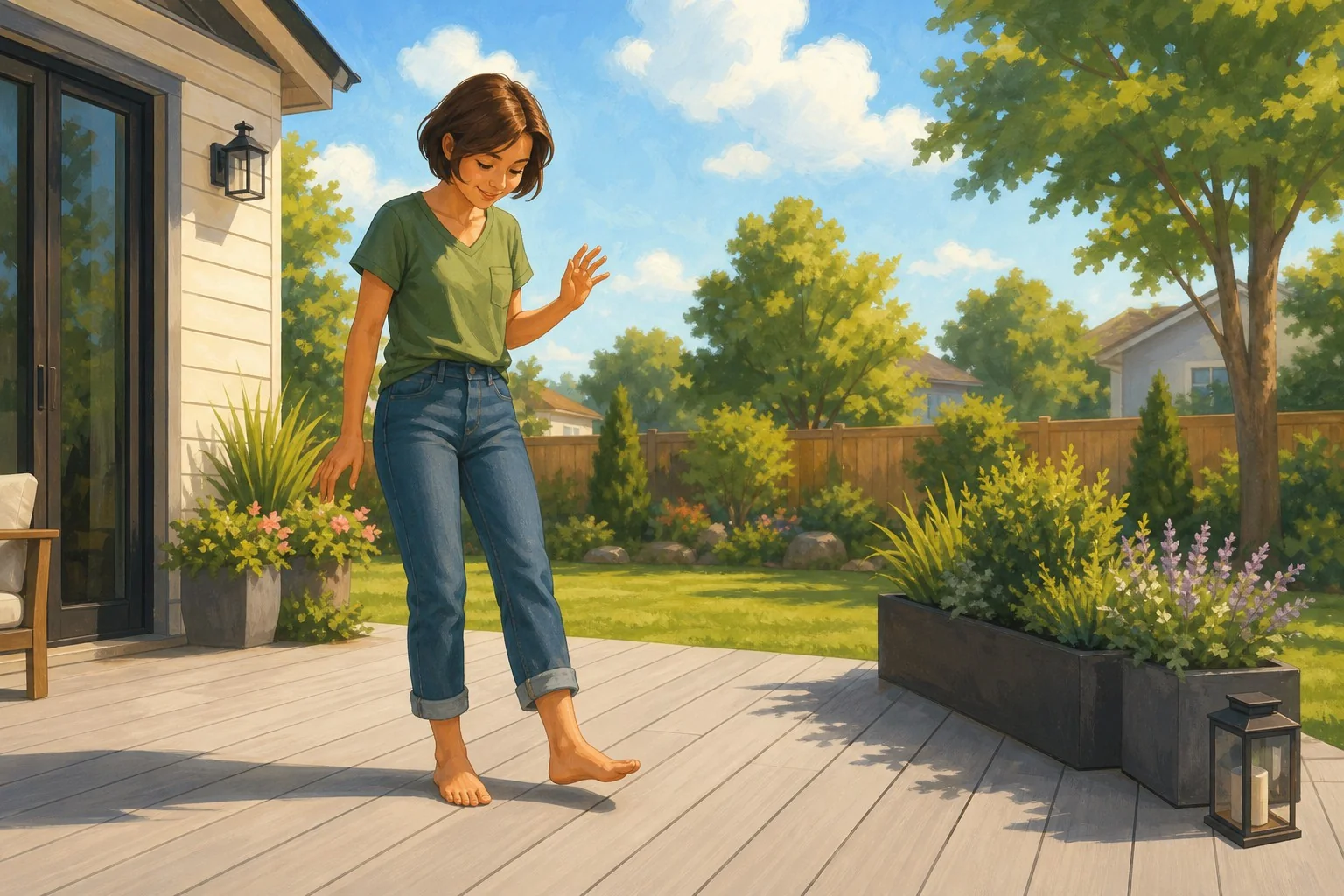
You ever run across your deck in July, barefoot, and thought your feet were about to catch fire? Yeah. Me too. And after thirty years of building decks all over Philly and the burbs, I can tell you it doesn’t have to be that way.
Here’s the deal. In peak summer around here — that mid-90s stretch with the sun beating down and no breeze — your deck surface can hit anywhere from 120 to 170 degrees. The number depends on three things: the material, the color, and how well air moves through the boards. Get any of those wrong and your kids won’t stand on it, your dog will refuse to walk on it, and you’ll be dumping water across it every time you want to grill.
The Actual Temperature Story
Pressure-treated pine in direct sun usually lands somewhere around 130 to 140. Uncomfortable, but survivable. A dark stained wood deck runs hotter — surprise, dark surfaces absorb more heat. Basic physics, no way around it.
Traditional composite — the kind with a lot of wood flour mixed in, especially in dark browns and grays — that stuff can get brutal. I’ve measured 165 on a hot afternoon. I had a customer in Blue Bell put in a beautiful dark espresso composite about six years back. First July after install, she called me on a Saturday morning. Her toddler stepped on it and started crying. She thought something was wrong with the boards. Nothing was wrong with the boards. It was 158 degrees on the surface. That’s what dark composite does in direct sun on a July afternoon.
Modern PVC decking — TimberTech Azek, Deckorators, the newer Advanced PVC lines — has come a long way. It’s lighter, denser, and the caps on the top surface actually reflect heat instead of soaking it up. In the same conditions where dark composite hits 160, a light-colored capped PVC board will often sit at 125 to 135. That’s the difference between “I need shoes right now” and “I can stand here with a beer and not think about it.”
So yes — the newer PVC and light-toned composites will beat a dark stained wood deck on temperature almost every time. But it’s not automatic. You have to pick right.
Tip 1: Color Matters More Than the Salesman Is Telling You
Here’s the honest truth. The material matters, but the color matters just as much. Sometimes more. A dark composite will roast you. A light gray or driftwood-tone PVC will not. If you want to stay barefoot in July, go light. Weathered wood tones, sand, gray, tan — all cooler than espresso, walnut, or black.
I get why people want dark decks. They look sharp. They hide dirt. Fine. But understand what you’re signing up for. If the deck faces south or west and has no shade over it, dark boards are going to punish you three months out of the year. Every year. That’s the tradeoff. Nobody puts it in the brochure.
Tip 2: Board Spacing Lets Heat Escape
This is the one nobody talks about. Standard deck installs leave a 1/8-inch gap between boards. That’s the minimum for drainage. But if you can push that to 3/16 or even 1/4 inch — especially with composite or PVC where the boards don’t shrink like wood does — you get better airflow underneath. Less heat gets trapped between the deck surface and the joists, and less of it radiates back up at your feet.
Boards butted tight together look neat on day one. By August they trap water, trap heat, and warp faster. Give the boards room to breathe.
Tip 3: Ventilation Under the Deck Is Not Optional
If your deck sits close to the ground and you’ve skirted the whole thing tight with lattice or solid panels, you’ve built yourself an oven. Heat gets trapped underneath, and it radiates right back up through the boards all afternoon and into the evening.
Leave gaps. Skip the solid skirt on at least one side, or run the openings on your lattice larger than the pretty little half-inch squares you see at the box store. You need actual airflow — not a decorative screen. Same idea as venting an attic. Trapped hot air is the enemy.
Tip 4: Shade Beats Every Material
The best cool-decking system in the world is a pergola, a shade sail, or a market umbrella. A dark composite deck in the shade stays cooler than a bright white PVC deck in blazing sun. Physics doesn’t care what you paid at the lumberyard.
If you’ve got the space and the budget, put something overhead. Retractable awnings mounted on the house wall work great for the section right by the door where people gather. Even a couple of well-placed umbrellas can knock 30 degrees off a hot spot.
What I’d Actually Build for You
If you called me today and said “Mike, I want a deck I can walk on barefoot in August,” here’s what I’d steer you toward. Capped PVC in a light tone — driftwood, sand, or a light gray. Boards spaced a hair wider than standard. Framing underneath with real airflow, not choked off by solid skirting. And if there’s no natural shade, I’d tell you to plan for a pergola or awning before you ever unfold the first umbrella.
Wood has its place. A well-built ipe or mahogany deck is a beautiful thing when the budget’s there and the homeowner is willing to oil it every year. But if you want low maintenance and cool feet during a Philly heat wave, the answer is PVC, light color, proper spacing. Simple as that.
Don’t let anyone talk you into a black deck on a west-facing yard. You’ll hate it by the Fourth of July.