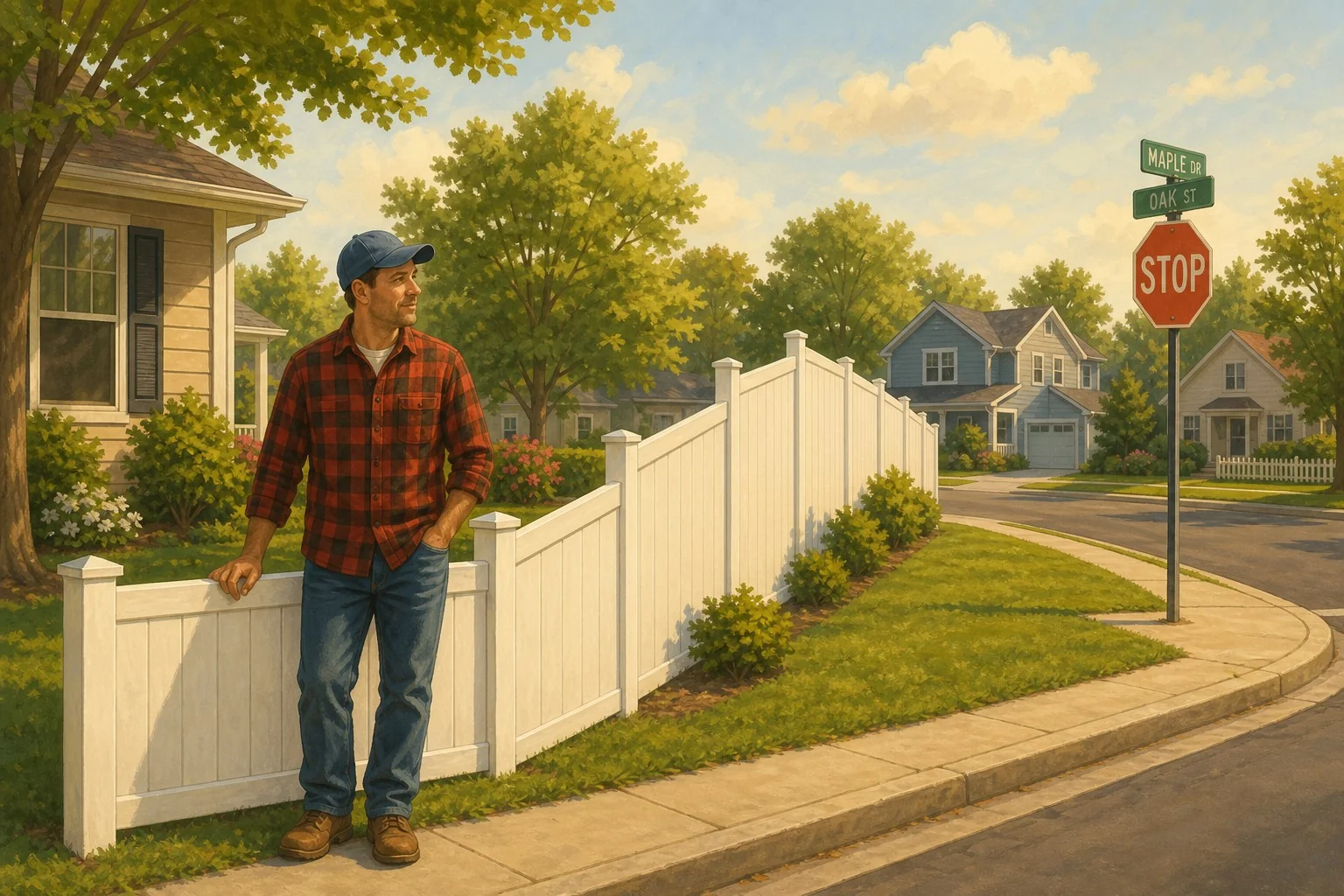
You bought the corner lot. Extra yard, extra light, extra room for the kids or the dog. Then you go to put up a six-foot privacy fence and the permit gets stamped DENIED. Welcome to the sight triangle.
Most homeowners have never heard of a sight triangle until it costs them time or money. Here’s what it is, why it exists, and how to keep it from wrecking your project.
What a sight triangle actually is
A sight triangle — sometimes called a sight distance triangle, corner visibility triangle, or clear vision area — is an imaginary triangle drawn across the corner of your property at an intersection. Inside that triangle, you can’t have anything above a certain height blocking a driver’s view of oncoming traffic, pedestrians, or bikes.
The exact dimensions vary by town. Some places use a straight 25-by-25-foot triangle measured from the corner. Others use bigger ones for higher-speed roads. Some measure from the property line, some from the edge of pavement, some from the curb. The height limit is usually somewhere between 30 and 36 inches — knee-high to hip-high — though I’ve seen 42 inches allowed in a few spots and stricter numbers in others.
That means your six-foot cedar fence, your neat row of arborvitae, your brick wall with the copper caps — none of it is legal inside that triangle. Doesn’t matter how nice it looks. Doesn’t matter that the neighbor two blocks over has one. If it’s in the triangle and it’s over the height limit, it’s coming down.
Why they exist (and why you should actually care)
Because people get killed at intersections when drivers can’t see. That’s it. That’s the whole reason.
A fence, a hedge, or a parked truck blocks the line of sight of a driver trying to pull out of a side street. They creep out, they can’t see, and they either sit there forever or roll into traffic and get hit. Same story for a kid on a bike coming down the sidewalk who a driver never spots until it’s too late.
I had a job in South Philly back in the nineties where the homeowner wanted a solid stucco wall around the whole property — corner lot, big money, wanted it done fast. We told him the wall had to step down near the intersection. He didn’t want to hear it, went over our heads, and hired some other guy who built it full height right to the corner. About a year later a woman in a Buick T-boned a kid on a scooter coming off that sidewalk because she couldn’t see past the wall until she was already in the intersection. Kid lived. The wall came down not long after, and the lawyers had a nice year.
That’s why the ordinance exists. It’s not the township being difficult. It’s somebody’s kid.
How to figure out what you’re actually allowed to build
Do this before you order materials, not after.
1. Call your zoning office. Not the building department — zoning. Ask specifically about corner lot sight triangle requirements, clear sight distance, or corner visibility ordinances. Get the dimensions, the height limit, and how they measure it. Ask them to email you the section of the code so you’ve got it in writing.
2. Read the actual code. Most municipalities post their zoning code on Municode, eCode360, or their own site. Search for “sight triangle,” “clear sight,” “corner visibility,” or “vision clearance.” Read the language yourself. Don’t take the word of the guy at the counter who’s been there for three weeks.
3. Mark the triangle on your property. If you have a survey, use it. If you don’t, get one, or at bare minimum walk the property with a tape measure and drive stakes at the corners of the triangle. You need to see exactly where the restricted zone falls on your lot before you draw a fence line.
4. Check the state DOT too if it’s a state road. State highways often have their own visibility rules on top of the local ones, and the stricter number wins.
What you can actually do on a corner lot
Plenty. You just have to work around the triangle instead of through it.
- Step the fence down. Full six-foot along the back and interior side yards, then drop to a 36-inch open picket or wrought-iron style through the sight triangle. It looks intentional, it’s legal, and it doesn’t scream “I ran out of money.”
- Landscape low. Ground cover, mulch beds, ornamental grasses that top out under the height limit. Skip the boxwoods, skip the arborvitae, skip anything with a mature height above the limit. They’ll grow into a violation and eventually somebody will complain.
- Pull the fence off the property line. You don’t have to build on the line. Moving the fence in a few feet sometimes lets you go full height around a smaller but useful yard, with the triangle sitting outside your fenced area entirely.
- Chase a variance only if you’ve got a real hardship. They’re rare, they cost money, and the zoning board is not going to grant one because you want more privacy. Save the effort unless there’s a genuine reason the standard rule doesn’t fit your lot.
Don’t skip this step
Homeowners who ignore the sight triangle end up in one of two places: tearing out a fence they just paid to install, or in front of a zoning board explaining themselves to their neighbors. Neither is fun. Neither is cheap.
Fifteen minutes with the zoning office up front saves you thousands on the back end. Make the call before you buy a single picket.