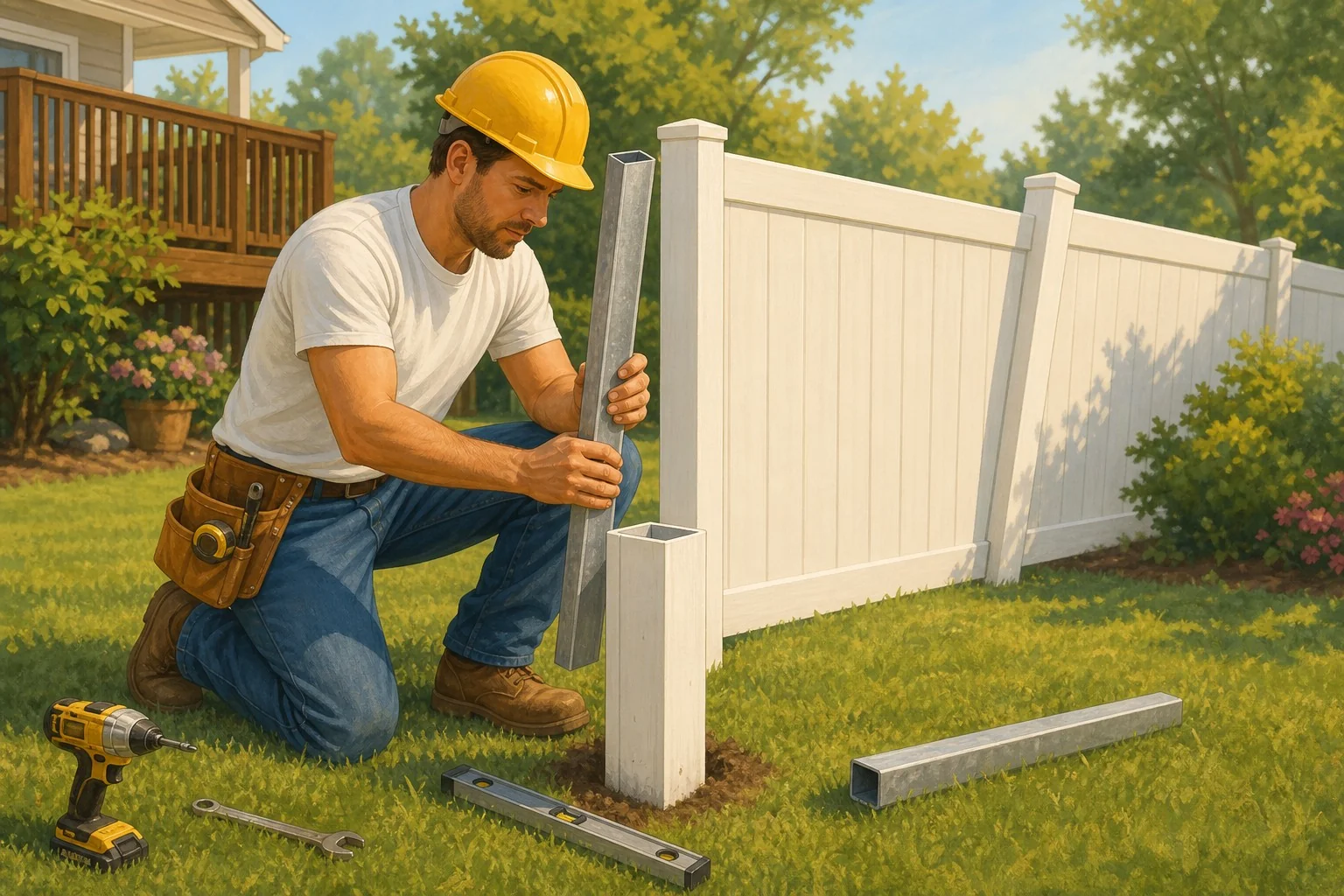
Vinyl fence is a good product. It doesn’t rot, doesn’t need painting, holds its color for years. But “low maintenance” doesn’t mean “install it loose and walk away.” There’s a version of vinyl fence that lasts twenty years and a version that sags, splits at the rails, and drops a gate on your kid’s bike by year three. The difference isn’t the brand. It’s whether someone put the right reinforcement inside it.
Here’s what actually needs to go into a vinyl fence if you want it to hold up — and why skipping it costs you double.
Rail Inserts: The Part the Sales Sheet Doesn’t Mention
Vinyl rails look solid. They’re not. The wall thickness on most residential fence rail is thin enough that over a long run, or in any meaningful wind, that rail will flex, bow, and eventually crack at the connection point.
The fix is aluminum inserts — hollow aluminum tubes you slide inside the vinyl rail before you hang it. They don’t add weight. They add rigidity. The vinyl becomes the weatherproof skin; the aluminum does the structural work. That’s how it’s supposed to work.
On a short run — say, a 6-foot section between two solid posts — you might get away without them for a while. But anything over two panels between posts, anything in an exposed yard, anything that’s going to catch full wind off an open field or a rooftop? You need the inserts. Rail without inserts in those conditions is just a matter of time.
The inserts are not expensive. They’re not hard to install — you put them in before the rail goes up. There is no good reason to skip them other than the installer not knowing what they’re doing or trying to cut twenty minutes off the job.
Gate Posts: This Is Where People Really Get Burned
A gate is a different animal than a fence panel. A fence panel just sits there. A gate swings, stops, swings again. Over years, that movement loads the post in a way a fence panel never does. If that post isn’t reinforced with steel — not aluminum, steel — it will twist. It will pull away from the footing. The gate will sag until it won’t latch, and then it won’t close at all.
I’ve seen it happen within eighteen months on a fence that otherwise looked fine. Homeowner called me in because the gate was dragging. We opened it up and the post had torqued almost ten degrees from vertical. The vinyl shell looked perfect. Inside was nothing — no steel, just hollow tube sitting in concrete. That post was never going to survive a gate.
For any gate post, you want a steel tube set inside the vinyl, embedded in concrete at the base. Size matters here too — a heavier gate needs a bigger steel insert. A single walk gate is one thing. A double drive gate is another conversation entirely. But the principle is the same: steel in the post, full stop.
If the person installing your fence tells you it doesn’t need it, ask them to put that in writing. They won’t.
Privacy Fences and Commercial Jobs: Go Heavier on the Post Wall
Standard residential fence posts are fine for a split-rail look or a decorative border. They are not fine when you’re building a 6-foot privacy fence that’s going to catch every gust of wind like a sail.
A taller fence has more surface area. More surface area means more wind load on every post. You want a heavier wall post — thicker vinyl, wider profile — especially at the corners and at any point where you’re making a direction change. Corner posts and end posts take more stress than line posts. That’s physics. Build accordingly.
This matters even more on commercial jobs. Commercial vinyl is a different product category: thicker walls, heavier gauge inserts, larger footings. If someone is pricing your commercial fence job at the same cost per foot as a residential backyard, something is wrong. Either they’re using the wrong material or they’re planning to cut corners somewhere. Either way, it’s your problem in year two.
What to Ask Before Anyone Starts Digging
You don’t need to know how to install a fence. But you should know how to ask the right questions. Before any crew starts setting posts on your property, ask:
Are you using aluminum inserts in the rails? If they hesitate, that’s your answer.
What reinforcement goes in the gate posts? The answer should be steel. If they say the vinyl is strong enough, find someone else.
What post profile are you using for the privacy sections? If it’s the same thing they use for a picket fence, push back.
These aren’t trick questions. A competent installer will answer them without blinking. They’ve been asked before. They know the answers. If the person you’re talking to gets defensive or vague, that’s a red flag you can’t afford to ignore.
The Short Version
Vinyl fence isn’t hard to do right. The right reinforcement — aluminum in the rails, steel in the gate posts, heavier profiles for tall or commercial runs — is standard practice, not an upgrade. It adds a little to the install cost. It takes a little more time. And it’s the entire difference between a fence that holds and a fence you’re replacing before your mortgage is halfway paid off.
Cheap installs are only cheap once.