July in Pennsylvania is a fence’s worst enemy. You get the heat, the humidity, and then some sky-cracking thunderstorm rolls in Tuesday afternoon and takes down half the block. If you haven’t looked at your fence since spring, now is the time. Not August. Not after the storm. Now.
Here’s the checklist I’d walk with if I was standing in your backyard.
1. Check the posts before anything else
The posts are the fence. Panels are decoration. If a post goes, the whole run goes with it, and no amount of pretty stain is going to save you.
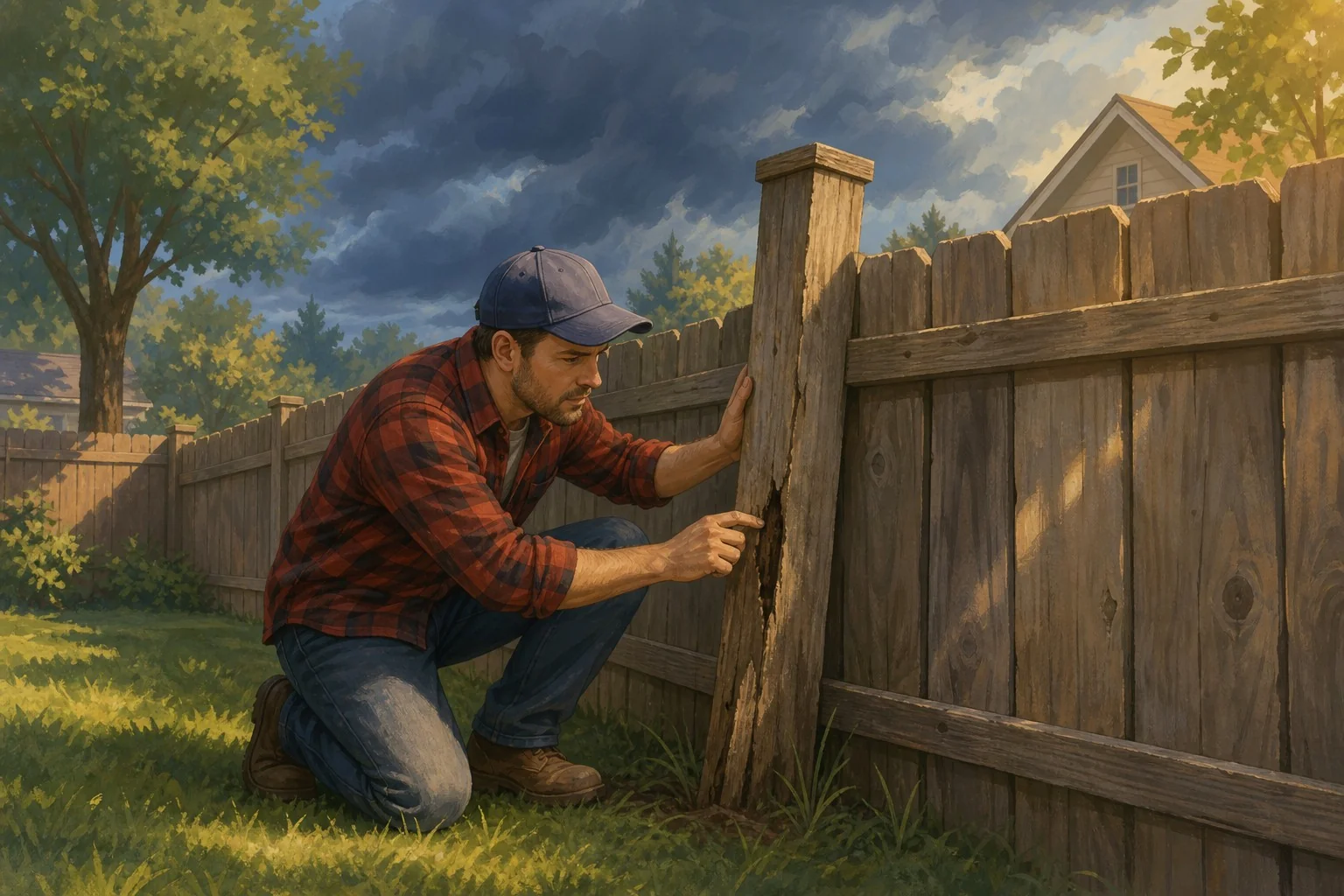
Grab each post and give it a good shove — both directions, like you actually mean it. It should not move. If you feel any wobble, any give at the base, any of that soft “hmm, that’s not right” flex, you’ve got a problem. Wood posts rot from the ground up because that’s where the water sits. The top can look brand new while the bottom is oatmeal.
Poke the base with a screwdriver. If it goes in easy, that post is done. Doesn’t matter how it looks. Rot doesn’t care.
For metal posts, you’re looking for rust at the base and any lean. A leaning post in July becomes a fallen fence in August when 60 mph winds hit it broadside.
A neighbor of mine over in Roxborough had me come look at his fence after a July storm knocked a full 40-foot run flat. He was ready to sue the fence company. I pulled one of the posts out with two fingers. Whole bottom was mush. That fence had been dying for three years and nobody bothered to check. Storm didn’t kill it — neglect did. The storm just showed up to collect.
2. Gates take the worst beating — inspect them like you mean it
Every gate on your property is a moving part attached to a stationary thing. That’s a fight the gate is always losing. Heat and humidity swell the wood, hinges sag, latches drift out of alignment, and by the time a storm hits, the gate is already stressed.
Open and close every gate on the property. If it drags, sticks, or you have to lift it to latch it — the hinges are shot or the post it’s hanging on is starting to move. Fix that now.
Check every screw in every hinge. I don’t care if the hinge looks fine. Put a driver on it and snug it up. Screws back out over time, especially in cedar or pine. A loose hinge screw in July is a broken gate in August.
If your gate has a diagonal brace, look at where it meets the corners. That brace is doing all the work keeping the gate square. If it’s cracked, split, or pulling away, replace it. It’s a $4 fix now or a new gate later.
3. Look at the panels, pickets, and hardware
Warping is the big summer villain. Wood moves with humidity, and cheap pickets warp fast. Walk the fence and sight down each run like a carpenter checking a stud. Anything obviously bowed, twisted, or pulling away from the rail needs a screw or a nail put back in it. Sometimes both.
Check every rail-to-post connection. On a nailed fence, humidity works the nails loose over years. If you see any nail heads sticking out past the wood, drive them back or replace them with 3-inch exterior screws. Screws hold. Nails eventually don’t.
Look for split pickets, especially near the top and bottom where fasteners bite. A split picket is a sail waiting for wind. Storms grab those loose boards and use them like crowbars on the rest of the fence.
If you’ve got vinyl fencing, walk it and push on the panels. Vinyl rails pop out of posts when the ground shifts or when a kid leans on them wrong. They look fine until you touch them.
4. Trees, branches, and what’s overhead
Half the fence damage I’ve seen in Philly wasn’t from wind. It was from what the wind knocked onto the fence. Walk your yard and look up. Any dead branch hanging over your fence line is a problem. Any half-dead tree leaning toward the fence is a bigger one.
You don’t need to be a certified arborist to spot an obvious hazard. If a limb looks dead, brittle, or cracked at the joint, get it down before a storm does it for you. A tree service call is cheaper than a fence rebuild and a lot cheaper than a fence rebuild plus a busted shed roof.
5. Drainage and the ground around your posts
Water pooling at the base of a post is the beginning of the end. Look at where your downspouts drain. Look at low spots where puddles sit for a day after rain. If your posts are sitting in a bathtub every time it storms, they’re rotting from the bottom whether you can see it or not.
Redirect the water. Extend the downspout. Regrade the low spot. Do whatever you have to do to keep standing water off the base of your posts. This is boring, ugly work and nobody wants to do it. Do it anyway.
The short version
Push every post. Work every gate. Sight every run. Look up at your trees. Look down at your drainage. If something wiggles, sags, splits, or squishes — fix it now. A weekend of maintenance in July beats a Sunday afternoon staring at your fence lying flat across the yard in August.
Storms don’t call ahead. Get out there this weekend.