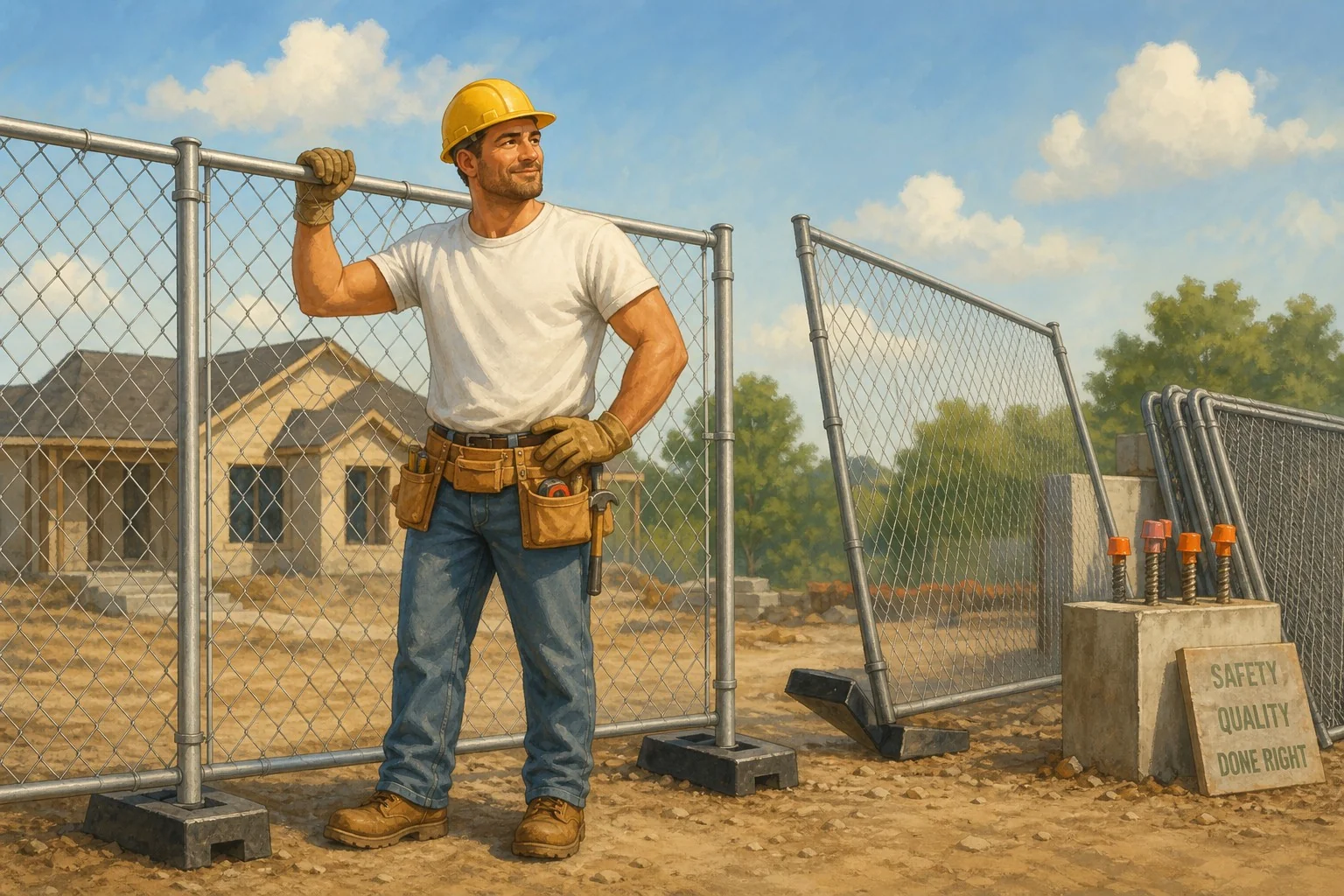
Temporary fence is the dumbest thing on a job site. There’s no skill in it. No measuring twice, no math, no crew of specialists. You put panels around the work, you lock the gate, you go home. That’s it.
So why does half the city screw it up?
Because guys treat it like an afterthought. The panels show up late. The crew is in a rush to start framing and figures they’ll close that one corner “after lunch.” Then OSHA shows up at 10 a.m., or the neighbor’s kid does, and now you’ve got a problem you didn’t need.
If you’re a homeowner paying for work on your house, the fence around your job is the first thing you should look at every morning. Not the framing. Not the drywall. The fence. Because if that’s wrong, everything else is at risk — your project, your wallet, and your liability.
Let me tell you what to look for. It’s not complicated, and there’s no excuse for any of it being wrong.
A fence with a gap isn’t a fence
I’ll say it plain. A fence with a gap is decoration. It’s a suggestion. It doesn’t keep anybody out and it doesn’t satisfy anyone with a clipboard.
Walk the perimeter of the job. Not from the sidewalk — actually walk the whole thing. Every side. If you can step through, slide through, or duck under, the fence is broken. Doesn’t matter if the rest of it looks great. The whole point of a perimeter is that it’s a perimeter. One open corner and it’s nothing.
I did a row house gut on a corner lot in Kensington a few years back. Panels went up first day, looked sharp, locked tight — except one corner where the delivery came up short. The lead said he’d close it the next morning. That afternoon a neighborhood kid wandered onto the slab, tripped over a pile of broken lath, scraped up his hands and went home crying. Nobody got hurt bad. Didn’t matter. OSHA did a routine pass two days later and cited us for every other thing they could find — fall protection, housekeeping, ladder tags. The open fence is what brought them over. The rest is what cost the GC about eleven grand. All because of a corner that “was getting fixed tomorrow.”
The fence is the first thing they see. It tells them what kind of job you’re running.
What a good temporary fence actually looks like
Forget what looks “fine.” Here’s what an inspector wants to see, what your insurance wants to see, and what your neighbors should see when they walk past at night.
- At least six feet tall. Chain link panels. Not snow fence. Not orange plastic mesh strung between t-posts. Mesh fence is for crowd control at a 5K, not a construction site.
- Real clamps between panels. Zip ties are not connectors. They’re trash. A 40 mph gust will turn a zip-tied panel into a sail and your fence into a domino line.
- Feet on every panel, weighted or sandbagged. Especially on hard surfaces. A panel standing on its own won’t survive a delivery truck swinging wide.
- A locked gate. Not propped shut. Not “the chain’s looped around it.” A real padlock. And only the foreman and the GC should have the key.
- Signage. “Construction Site — No Trespassing” and “Hard Hat Area.” Cheap, required, and it shifts liability the right direction if somebody ignores it and gets hurt.
That’s the whole list. None of it is hard. None of it is expensive.
Walk it every morning. Walk it again at the end of the day
Fences move. Wind moves them. Trucks bump them. Subs cut them open to drag in material and forget to put them back. The fence you had at 8 a.m. is not the fence you have at 4 p.m.
If you’re the homeowner, this is the easiest job-site check you’ll ever do. Walk it. Look for gaps. Look for panels that are leaning. Look for a gate that someone left open because they were running material through and figured nobody would notice. If you see something, say something — and don’t accept “we’ll get to it.” That’s the exact sentence that turns into a citation, a lawsuit, or a kid in the ER.
Why this matters more than you think
A construction site is what the law calls an attractive nuisance. Translation: if a kid wanders in and gets hurt, you don’t get to say “well, he shouldn’t have been there.” The law expects you to know kids are curious and to put a fence between them and the drop-offs, the rebar, the nails, the open trenches, and the half-stacked pallets ready to fall on somebody.
Then there’s theft. Copper, tools, lumber, the new windows sitting in the dining room waiting to be installed. Walk any city neighborhood at midnight and tell me which sites are getting hit. It’s always the ones with a sloppy perimeter. Always.
And then there’s the inspectors. OSHA, L&I, whoever your jurisdiction sends. The fence tells them everything before they’ve even pulled out a notepad. A tight, locked, well-marked perimeter says “this crew gives a damn.” A sagging panel held up by a cinder block says “go ahead, look harder, you’ll find plenty.” They will.
The bottom line
Temporary fencing is the easiest part of a job to do right. Six-foot panels. Real clamps. Weighted feet. Locked gate. Signs. Walked twice a day. That’s it.
If your contractor can’t pull that off, ask yourself what else he’s not pulling off that you can’t see from the curb. Because the fence is the part you can see. Everything behind it is the part you have to trust him with.
Trust the guy who gets the easy stuff right.