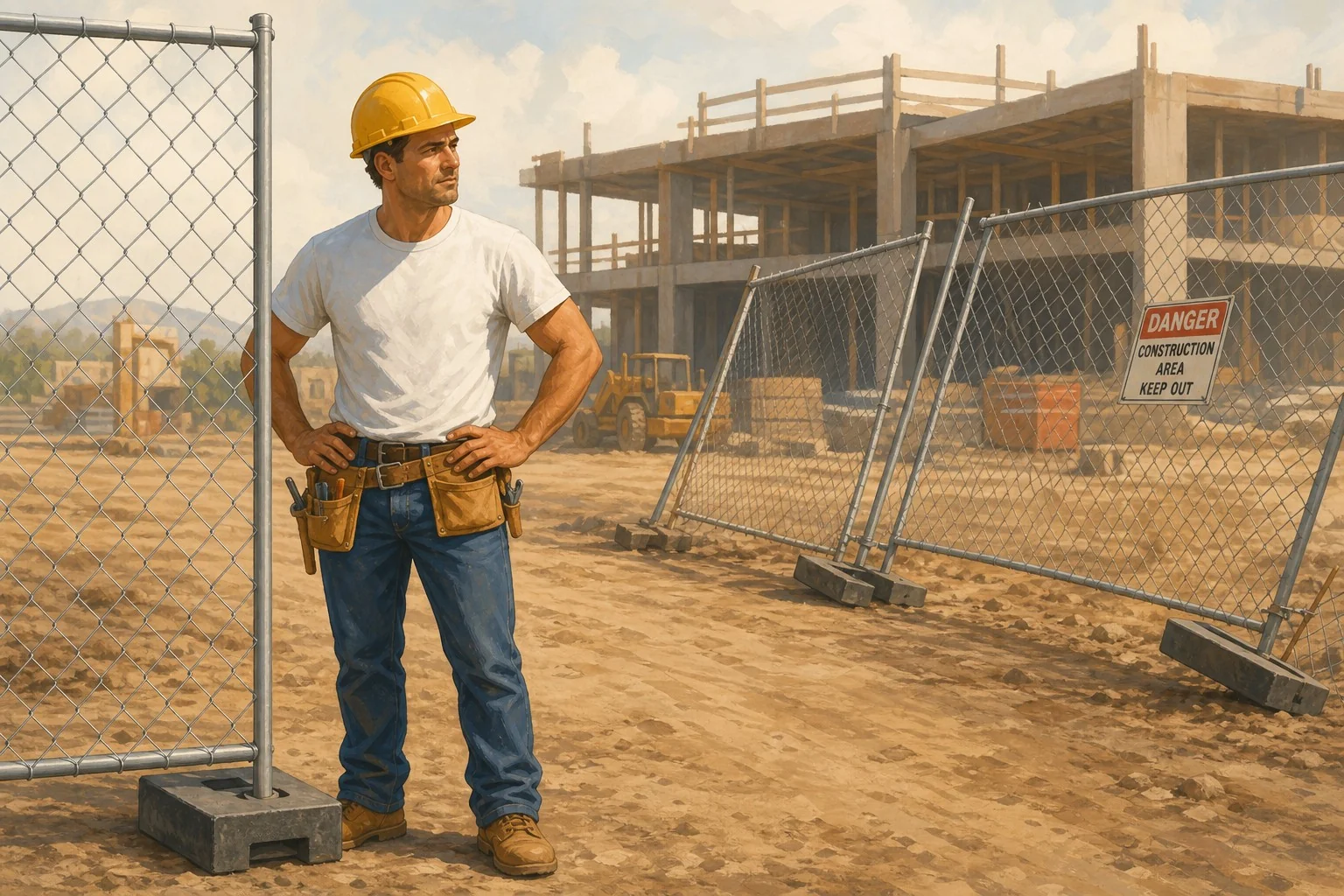
You hired a contractor. You wrote the check. You’re excited about the new kitchen, the addition, the back deck — whatever it is. Good. Now go look at the fence around your job site.
If you can’t tell whether it’s actually doing anything, that’s a problem. Most temp fences aren’t fences. They’re suggestions. And a suggestion isn’t going to stop a curious six-year-old, a drunk neighbor, or an inspector with a clipboard from walking right onto your property and ruining your day.
Here’s what nobody tells homeowners: when something goes wrong on a poorly secured site, you’re in it too. The insurance fight, the stop-work order, the lawsuit if some kid gets hurt — it doesn’t matter that you’re not the one who set up the fence. It’s your address. So learn what a real one looks like, because you’re going to be writing checks either way.
A Real Fence Encloses the Whole Site. No Excuses.
I don’t care if your contractor swears they’ll “finish that side tomorrow.” Tomorrow is a magic word in construction and it usually means never. The fence either goes all the way around the active work area on day one or it doesn’t count.
That means the street side, the neighbors’ side, the back yard nobody’s looking at, and the alley you forgot existed. It means around the dumpster, around the porta-john, around the materials pile. If a kid on a bike could ride between two panels and end up next to your foundation hole, your site is not secured. Period.
Half a fence is worse than no fence. No fence at least signals danger. Half a fence tells everyone it’s safe to walk in.
Panels Have to Be Clamped Tight. Leaning Doesn’t Count.
I walk past job sites every week where panels are just resting against each other. No couplers. No clamps. Sometimes they’re zip-tied like that’s going to do anything in a real wind. Push on one with two fingers and the whole run rocks like dominoes. That’s not a fence — that’s a stack of metal waiting for an excuse to fall down.
What you want to see at every joint: a metal coupler, locked tight, top and bottom. Not wire. Not packing tape. Not “we’ll come back and fix it.” If the panels move when you lean on them, they’ll move when a kid leans on them.
Stands and Weights Aren’t Optional
Cheap plastic stands tip over. Light stands fly. Around here, the wind funneling between rowhomes will pick up a panel that isn’t weighted and put it through a parked car. I’ve seen it happen more than once, and the homeowner ends up arguing with the neighbor’s insurance company over a windshield that wasn’t theirs to break.
If your site is on a tight street, a corner lot, or anywhere the wind has a clear shot, you want concrete or filled stands. Your contractor’s job is to know that and price it in. Your job is to ask. If they wave it off like you’re being paranoid, that tells you something about the rest of the work too.
Gates That Actually Close
This one is so stupidly common it makes me want to scream. Crew leaves for the day, and the gate is “closed” with a piece of looped wire or one of those flimsy zip ties. That’s not a gate. That’s a polite request.
A real gate has a real latch, a real lock, and a real key. If your contractor can’t tell you who has keys to the site at the end of the day, you’ve got a bigger problem than the fence. You’ve got a contractor who doesn’t take site control seriously, which usually means they don’t take a lot of things seriously.
While we’re here: that gate needs to be locked even when the crew goes to lunch. An hour is plenty of time for someone to wander in, get hurt, and turn your renovation into a deposition.
The Gaps Nobody Notices
The dumpster. The corner where two runs meet. Behind a stack of lumber. The spot where the fence had to go around a utility pole. These are where I find every failure when I do a walk-through. Sites get shut down over gaps the homeowner never even saw.
Job in South Philly a while back — tight street, rowhomes on both sides, foot traffic all day. The fence looked clean from the curb. Inspector walks the perimeter and finds a two-foot gap behind a dumpster nobody had bothered to seal off. That was it. Job paused. Didn’t matter that the rest of the site was buttoned up tight. One gap and you’re an unsecured site, and the inspector writes you up for the whole thing.
There is no partial credit here. Either it’s locked down or it isn’t.
What to Demand From Your Contractor
You don’t need to be a site safety expert. You need to ask three questions before they break ground:
- Who is responsible for the temp fence, and when does it go up? It should be up before the first wall comes down or the first hole gets dug. Not after.
- How is it being secured? You want to hear “couplers, weighted stands, locking gate.” If you hear hemming and hawing, push.
- Who walks the perimeter at the end of every shift? Somebody needs to be checking every gap, every joint, every gate, every day. If nobody’s doing it, everybody’s doing it badly.
If you get vague answers to any of those, that’s your answer.
A site that isn’t controlled is a site that’s already in trouble. Don’t let it be yours.