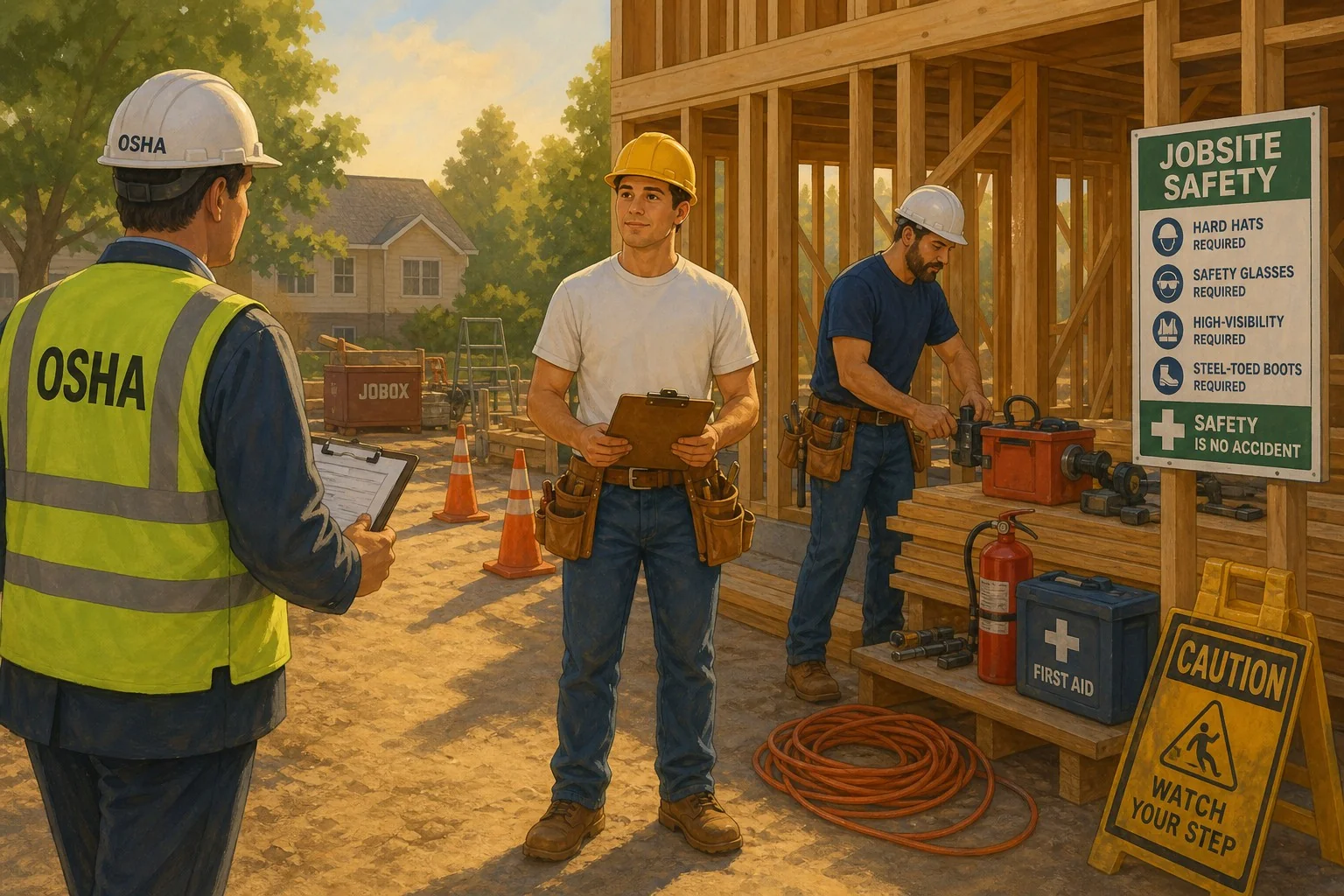
Most homeowners have never seen an OSHA inspection up close. You hear about them when something goes bad — a guy falls, a scaffold collapses — but the day-to-day reality of a site visit is a lot quieter than that. It’s also a lot more revealing.
Here’s what actually happens, and what it tells you about the people building your house.
How It Usually Goes
An inspector pulls up, walks the perimeter, and watches. That’s it. They’re not there to help you. They’re not there to warn you. They’re there to observe, document, and write citations if they find violations.
The first ten minutes tell them almost everything. Where’s the gear? Who’s wearing it? Is the site organized or is it a disaster? How does the crew behave when a stranger shows up?
An experienced inspector has seen every job site tell from twenty feet away. They don’t need to get close to know what they’re walking into.
What Most Crews Do Wrong
The worst thing you can do when OSHA shows up? Start scrambling.
Guys running for harnesses they weren’t wearing. Ladders getting moved mid-inspection. Foreman raising his voice, trying to herd everyone into compliance in real time.
That behavior doesn’t hide the problem. It broadcasts it.
I had a West Philly rehab where the foreman — usually a solid guy — panicked the second he spotted the OSHA truck. Started shouting, crew started moving equipment, guys pulling hard hats out of their trucks like they’d just remembered they owned them. The inspector stood on the sidewalk and took notes without saying a word. Walked the site at his own pace and wrote up everything he’d already clocked from the street before he even stepped onto the property. What should’ve been a minor citation turned into a full write-up because the scramble made it obvious how the site normally operated.
Inspectors can smell panic from the sidewalk. That scramble sends one message: you’re only safe when someone’s watching.
What They’re Actually Looking For
Falls are the priority. Fall protection — harnesses, guardrails, hole covers — is what OSHA is focused on in residential and light commercial work. A guy on a roof without a harness is a citation. An unguarded floor opening is a citation. An unsecured ladder is a citation.
Beyond falls, they’re looking at housekeeping (is the site a trip hazard?), electrical (extension cords, live panels, temporary power), and whether anyone on-site actually knows what the safety plan is.
On commercial jobs you get into more — confined spaces, hazard communication, respiratory protection. But for the homeowner watching a kitchen gut or a second-floor addition, fall protection is where most of the violations land.
What It Means for You as a Homeowner
If you’re home and OSHA rolls up on your job, watch how your crew responds. That response tells you more about the contractor than anything they said during the sales pitch.
A well-run crew doesn’t scramble. They already have the harnesses on. The site is already clean. The foreman walks over, introduces himself, and lets the inspector do his job. That crew has nothing to hide because the way they work every day is how they’re working right now.
A crew that panics? That crew operates differently when no one’s looking. And on your job, nobody’s looking most of the time.
What To Do If It Happens
Stay out of the way. The inspector is there to observe, not to have a conversation with you. Don’t try to explain things or stick up for your contractor. You’ll make it worse, and it’s not your place.
Watch how the crew reacts. A calm crew with their act together is worth something. A crew falling over each other trying to put on gear they should’ve been wearing all along — that’s information you needed before you signed the contract.
Ask for the inspection report. If citations are issued, your contractor is responsible for the fines and for correcting the violations. It doesn’t typically become your legal liability as a homeowner, but it can slow your project down. If your contractor won’t give you the report, that tells you something too.
The Bottom Line
An OSHA inspection isn’t a crisis. It’s a measurement. It measures exactly how your crew operates when the stakes are real.
The job sites that pass clean aren’t lucky. They’re run by people who don’t cut corners when the inspector is there because they don’t cut corners when he isn’t. That’s not some special skill. That’s just doing the job right.
If your crew suddenly starts “fixing things” the moment an inspector walks up, you’re already too late. The question isn’t whether you’ll get cited. It’s whether you should’ve known who you hired.