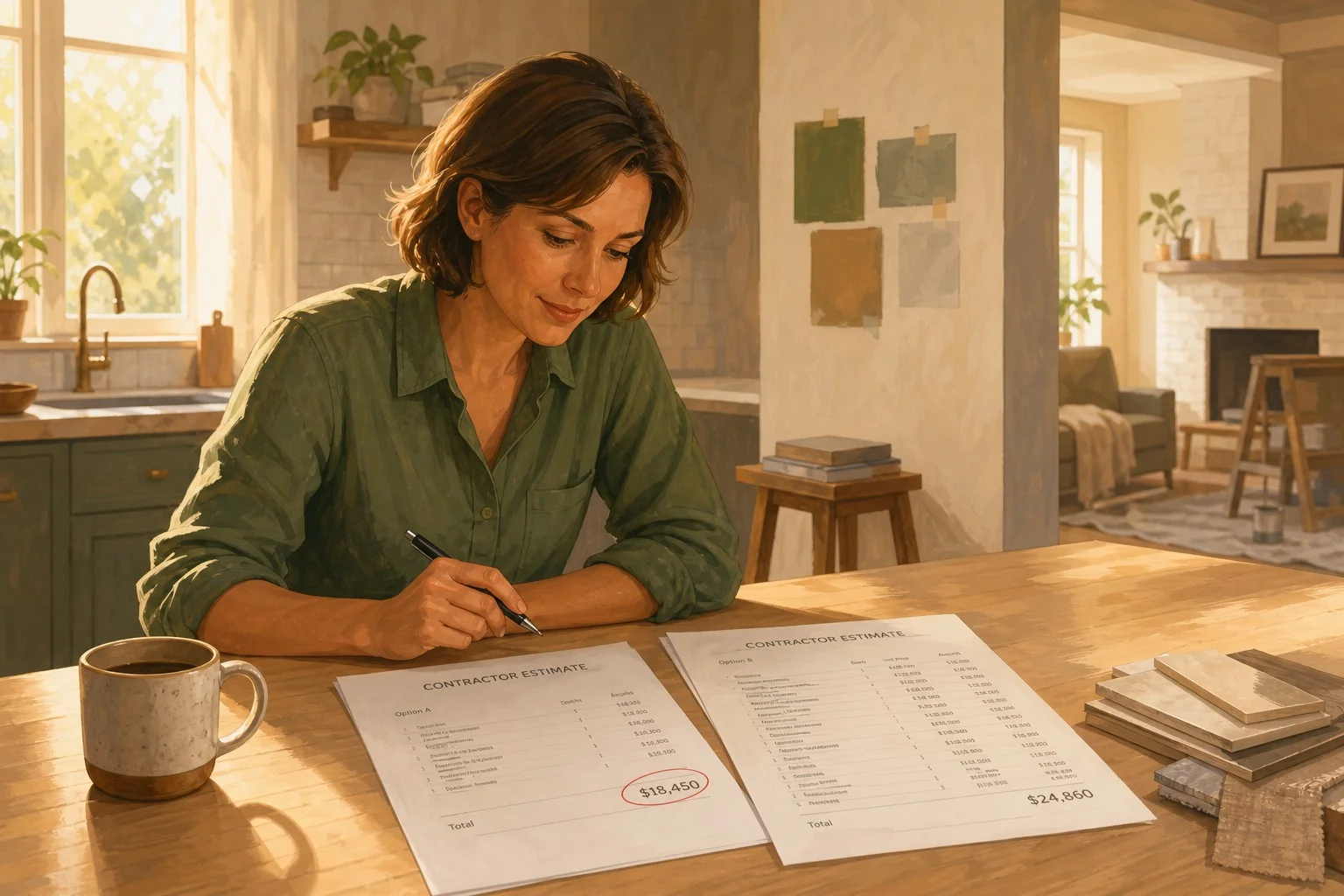
Homeowners ask me all the time: “Mike, which bid should I take?” And they slide three estimates across the kitchen table like I’m supposed to be a fortune teller.
Here’s the truth. The number on the bottom of the page is the least useful piece of information on it.
The number matters less than understanding exactly what you’re paying for. I’ll say it again because it’s the whole game — the number matters less than understanding exactly what you’re paying for. Two bids can be $8,000 apart and the cheap one ends up costing you twice the expensive one by the time the job is done. That’s not a scare tactic. That’s just how this business works when you don’t read the paperwork.
Let me walk you through what actually matters.
1. The cheap bid is almost never actually cheap
When you get three estimates and one of them is way lower than the other two, that low number isn’t a gift. It’s a signal. Something is missing. Either the guy forgot to include something, is planning to include less than the other two, or he’s going to hit you with change orders the second he opens up the wall.
A few years back I got called into a house in Fishtown to finish a kitchen after the homeowners fired their first contractor. Original bid was $22,000. The next lowest was $34,000. Guess which one they picked. By the time that first guy walked off the job, he’d already collected $28,000 and the cabinets weren’t even hung. Every single thing was “extra.” Demo? Extra. Rerouting the drain because the old one didn’t meet code? Extra. Drywall repair after his own guys punched a hole in the wall? Extra. They ended up paying me another $19,000 to finish it right. That $22,000 bid cost them $47,000.
The lesson isn’t “always pick the expensive guy.” The lesson is that a number by itself tells you nothing. What you need to know is what’s inside that number and what’s not.
2. What actually goes into a real estimate
A real estimate — not a napkin scribble, an actual estimate — breaks down into four things: materials, labor, overhead, and profit. If you can’t see roughly how those four are being handled, you’re not looking at an estimate. You’re looking at a guess.
Here’s what to look for:
- Materials should be specific. Not “cabinets.” What brand, what line, what finish, what door style. Not “flooring.” What species, what grade, what thickness, what finish. “Contractor-grade” is a term that means “cheapest thing I can find at the supply house that day.” That’s not what you want to be paying for without knowing it.
- Labor should have some breakdown. You don’t need a stopwatch report. You need to know if demo is included, if haul-away is included, if painting is included, if the electrician and plumber are subs on his ticket or if you’re supposed to hire them yourself. That last one blows up more budgets than anything else.
- Overhead and profit are real and legitimate. Any contractor who tells you he doesn’t charge overhead is either lying or going out of business. Trucks, insurance, workers’ comp, tools, fuel, the office lady who answers the phone — that all costs money. A guy running a real business is going to build 15 to 25 percent into the number for that. That’s not gouging. That’s arithmetic.
- Allowances should be flagged clearly. If your estimate has a $3,000 “tile allowance,” that means the tile hasn’t been picked yet and if you walk into the showroom and fall in love with $6,000 worth of tile, the extra $3,000 is on you. Know your allowances before you sign anything.
3. The payment schedule tells you who you’re dealing with
Read this part carefully. A guy who wants 50 percent up front on a $40,000 job before he’s ordered a single stick of lumber is telling you something about how his cash flow works, and it’s not good. A reasonable schedule looks something like: a deposit to hold the date and cover initial materials, progress payments tied to milestones you can see with your eyes, and a final payment held back until the punch list is done. Not until “the job is done.” Until the punch list is done. Those are different things.
If a contractor pushes back hard on holding a final payment until punch list completion, that’s your answer. Politely thank him for his time.
4. Ask these questions before you sign anything
Doesn’t matter if he’s your brother-in-law’s cousin. Ask them.
- What exactly is included in demo and cleanup?
- Are permits and inspections in the number, or separate?
- Who is pulling the permit — you or him? (Hint: if he wants you to pull it as a homeowner on a big job, run.)
- What happens if you open the wall and find something we didn’t plan for?
- What’s the change order process, and does every change get priced in writing before work continues?
- How are subcontractors handled — are they on your ticket or mine?
- What’s your warranty on workmanship, and what does it not cover?
If the guy gets annoyed at any of these questions, that’s the whole interview right there. A pro answers them without flinching because he’s answered them a thousand times.
The bottom line
A good contractor wants you to understand exactly what you’re buying. He’ll walk you through the number line by line and explain the trade-offs. He’ll tell you where he could save you money if you wanted a different grade of material, and where he absolutely wouldn’t cut corners even if you asked him to. That conversation is what you’re actually shopping for. Not the number.
Pick the estimate you understand. The one where you know what’s in it, what’s not in it, and what the guy is going to do when something surprises him — because on any job worth doing, something will.
That’s the bid worth signing.