You own the land. You do not own the right to do whatever you want on all of it. That’s the whole ballgame with easements, and it’s the reason perfectly nice people end up ripping out brand-new fences, moving sheds with a Bobcat, or watching a backhoe drive through their new patio because a water main sprung a leak three feet under the pavers.
Nobody warns you about this stuff at closing. The title company slides a stack of paper across the table, you sign your name forty times, and everybody moves on. Then two years later you decide you want a fence, and suddenly a guy from the utility company is standing in your yard telling you the six-foot cedar privacy fence you just spent nine grand on has to go.
Let’s fix that before it happens.
What an easement actually is
An easement is a legal right for somebody else — a utility, the township, a neighbor, sometimes the general public — to use a specific strip of your property for a specific reason. You still own the dirt. You still pay taxes on it. You just can’t block, build over, or interfere with whatever the easement is there to protect.
Three flavors show up on residential lots more than anything else:
- Utility easements. Gas, electric, water, sewer, cable, fiber. Usually along the front, back, or side lot lines. Sometimes cutting right through the middle of the yard where a main runs.
- Drainage easements. These protect the path water is supposed to take when it rains. Swales, culverts, retention basins. Mess with the grade and you’re not just violating an easement — you’re flooding your neighbor.
- Access easements. Someone else has the right to cross your land to get to theirs. Common on flag lots, shared driveways, and older properties where the road layout was drawn up before your great-grandfather was born.
The kicker: the utility or township doesn’t need your permission to dig. They gave you notice years ago, in the paperwork, and that was that.
How to actually read your deed and plot plan
Most homeowners have never read their own deed. I get it — it reads like it was written by a lawyer who was paid by the word. But you don’t need to understand every “whereas” and “heretofore.” You need to find one section and read it carefully.
Here’s the drill:
- Pull your deed. You got a copy at closing. If you can’t find it, your county’s Recorder of Deeds office has it, usually online, usually free. Search by your name or address.
- Look for the words “subject to.” That phrase is where the easements live. “Subject to easements of record,” “subject to a 10-foot utility easement along the rear property line,” “subject to the drainage easement recorded in Book X, Page Y.” Read every one of them. Every single one.
- Get the plot plan or plat map. This is the drawing that shows your lot with dimensions and — critically — dashed or hatched lines showing where the easements physically sit. Your deed alone will tell you an easement exists. The plat tells you where.
- Cross-reference with the recorded plat at the county. Sometimes what you got at closing is a simplified sketch. The recorded plat at the courthouse or planning office is the real one. If there’s a difference, the recorded version wins.
- Call the title company that closed your deal. They ran a title search. They know exactly what’s on your parcel. Most will send you the commitment or the exception list if you ask nicely.
If any of that feels over your head, a surveyor can do it for you for a few hundred bucks. A surveyor with a stake gun and a plat map is worth every penny before you start digging post holes.
What to look for before you design anything
Once you know where the easements sit, look at your project through that lens before you draw up plans.
- Anything with a footing — fence posts, deck piers, shed foundations, pool walls — is a problem inside an easement. It’s an obstruction, and it’s what the utility will tear out first.
- Grade changes inside a drainage easement will bite you. Raise it, dig it out, add a retaining wall — you’ve just redirected water, and the township will make you undo it.
- Landscaping counts too. Big trees over a sewer lateral or a water main are asking for trouble. Roots find pipe. Pipe breaks. Guess who pays to dig it up and who pays to replace the tree.
- Sheds and pergolas feel harmless because they’re not “permanent.” Utilities don’t care. If it’s on their easement and they need to dig, it’s coming down.
- Driveways and pavers are less catastrophic — they can be pulled up and put back — but “put back” is doing a lot of work in that sentence. You’ll pay for it, not them.
Rule of thumb: if it’s inside an easement, assume you’ll have to remove it someday. If you can live with that, fine. If you can’t, don’t build it there.
The war story
Had a homeowner up in Roxborough hire me to put in a nice cedar privacy fence — real posts, concrete footings, the works. Beautiful yard. She had a copy of a sketch from her real estate agent that showed clean lot lines and no notes. I asked if she’d pulled the actual plat. She hadn’t. I told her to, she waved it off, said she’d been on the property fifteen years and never had a problem. Ten months later PECO shows up because a transformer down the block needed a new feed, and there’s a ten-foot utility easement running right along her back line. They pulled forty feet of fence out with a truck and left it in a pile. She called me screaming. I told her what I told her the first time. Cost her another eight grand to redo it inside the property line where the easement wasn’t. Fifteen minutes at the county office would have saved her all of it.
That’s not a rare story. That’s a Tuesday.
Bottom line
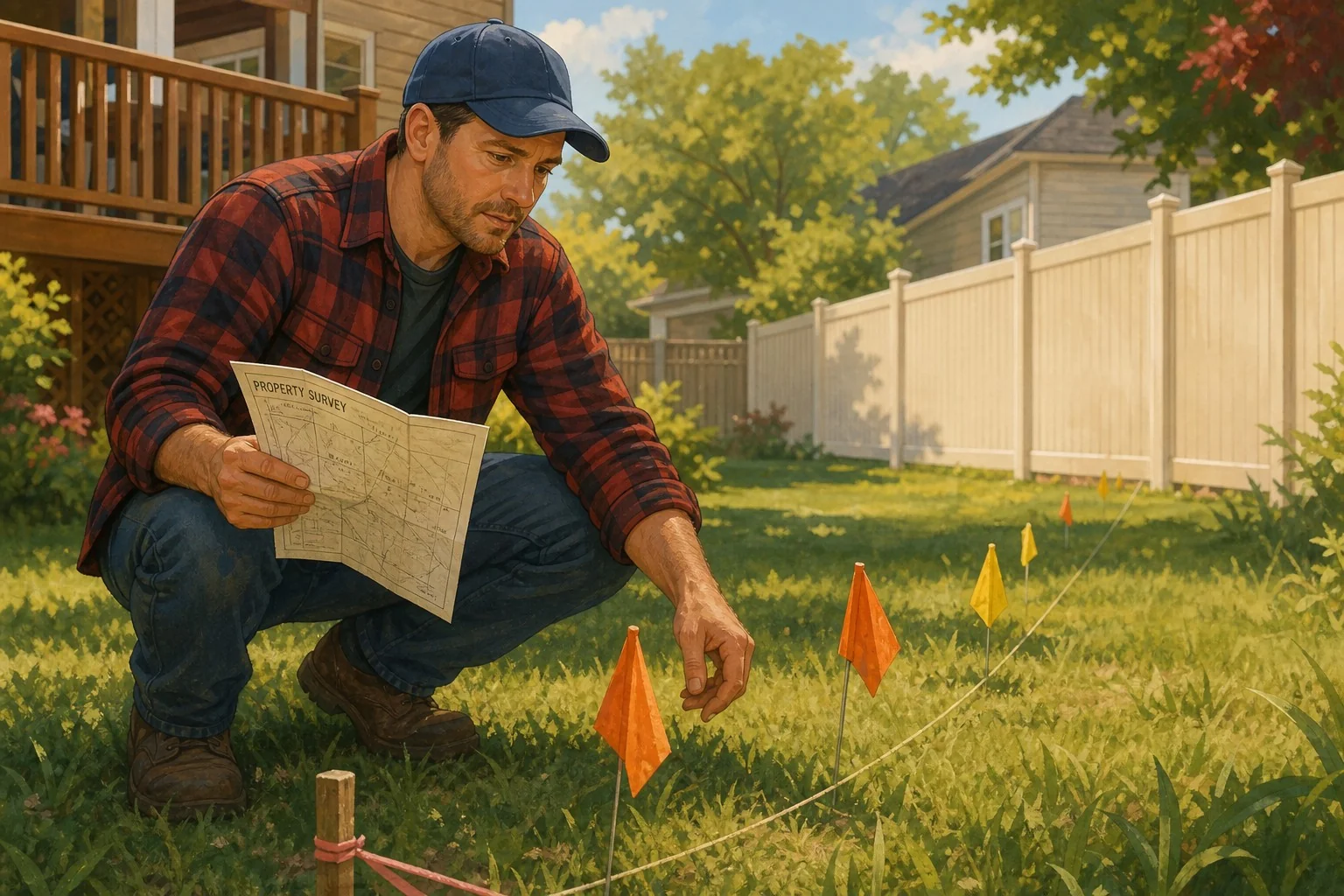
Before you design a fence, a shed, a pool, a patio, a garage — anything that puts something permanent in the ground — pull the deed, pull the plat, and read the “subject to” section. If you see an easement, map it out on your own property with a tape measure and some flags before you commit to a design. Move your plans in a few feet if you have to. It is a hell of a lot cheaper to redraw a fence line than to tear one out.
Your deed already told you where you can’t build. Nobody’s fault but yours if you don’t read it.