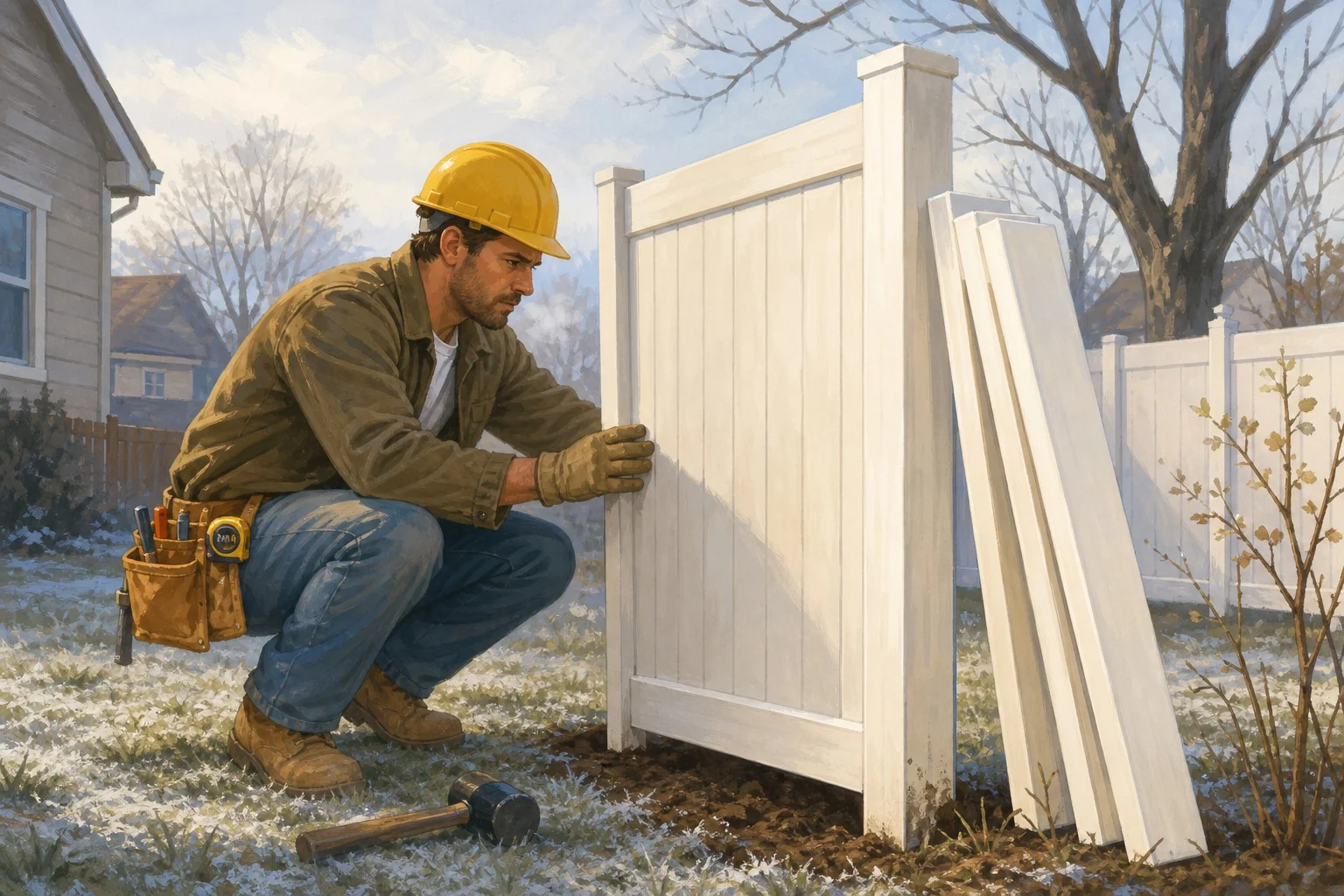
Vinyl fence looks easy to install. That’s part of why so many people screw it up.
The material is lightweight, the posts snap together, and the whole thing looks like a weekend project you can knock out before the Eagles game. And it is — if you understand one thing that the box store won’t tell you clearly enough: vinyl moves. A lot. More than wood, more than most people expect. And if you ignore that, the fence you put up in February is going to look like a crumpled straw wrapper by August.
Here’s what you need to know.
Vinyl Is Not Wood. It Doesn’t Behave Like Wood.
Wood moves with moisture. Vinyl moves with temperature. Those are completely different problems, and they require different thinking.
A standard 6-foot vinyl fence panel can expand or contract by a quarter to half an inch depending on how wide the temperature swing is. That might not sound like much. Multiply it across a 100-foot run of fence — multiple panels, multiple rails — and you’ve got real movement happening. Every joint, every connection point, every place a rail slides into a post has to accommodate that movement or something is going to crack.
PVC — which is what vinyl fence is made of — gets brittle in cold weather. When it’s warm, it’s flexible enough to absorb some abuse. At 20 degrees, it snaps clean. That’s not a flaw in the material; it’s just physics. Handle it accordingly.
Don’t Force Anything When It’s Cold
This is where most installs go sideways. You’re working in late fall or early winter, it’s 35 degrees, and the rails feel like they don’t quite want to seat into the post holes. So you force them. Maybe you use a rubber mallet, maybe you push hard with your shoulder, maybe you just muscle it together because it’s close enough and you want to go home.
Don’t.
Cold vinyl is contracted. It’s shorter than it will be in July. If you force it tight in cold weather, you’ve got panels and rails with no room to grow once temperatures climb. The pressure has to go somewhere. It’ll crack a panel, it’ll bow a rail, or it’ll blow out a post cap. You’ll know it happened the first time you have a real summer.
When it’s cold and the material is being stubborn, slow down. Let it tell you something.
Leave the Expansion Gaps. All of Them.
Every manufacturer specifies expansion gaps for a reason. These are the small spaces — usually an eighth to a quarter inch — left at the ends of rails where they insert into posts, and sometimes between panels depending on the system.
Leave them. All of them. Don’t eyeball it; measure it.
I’ve seen homeowners close those gaps because they thought the fence looked “sloppy” with the little bit of space showing. Then they call someone the following summer because the fence looks like it’s been through a war. It was fine. They fixed the wrong problem.
If you’re installing in cold weather specifically — say below 40 degrees — go to the larger end of whatever gap range the manufacturer gives you. The material is already contracted. Give it room to expand when it warms up.
Store the Material Right Before You Install
This one gets overlooked. If your vinyl fence has been sitting in an unheated garage or on the back of a truck in January, it’s cold-soaked and contracted. You put it up in that state and every measurement you’re making is off from where it’ll end up at normal temperatures.
Two options. Either bring the material inside — ideally to a heated space at 60 degrees or above — and let it normalize for a day before you work with it. Or if the sun is out and it’s not brutal, lay it out in direct sunlight for a few hours before install. Vinyl absorbs heat from sunlight faster than you’d think. Either way, you want the material close to its neutral temperature before you start cutting and setting.
Don’t skip this. It’s not extra work — it’s an hour of patience that saves you a weekend of fixes later.
Cold-Weather Installs: What to Actually Do
Concrete for the posts still needs to cure properly, and that process slows down significantly in cold weather. Below 40 degrees, standard concrete mix won’t cure right without additives or some kind of protection. If you’re setting posts in cold temps, use a fast-set mix rated for cold weather, or use a heated enclosure around the base until it sets. Don’t just pour it and hope.
Post depth matters year-round but especially in areas with freeze-thaw cycles. Philadelphia winters will heave an underpowered post right out of the ground. Get below the frost line — 36 inches in most of the Mid-Atlantic. Don’t cut corners on depth because the hole is hard to dig.
One other thing: don’t install when there’s frost in the ground right where you’re setting posts. The ground will shift when it thaws. That post you set perfectly plumb will be leaning by spring. Wait for a clean thaw or use a ground thaw blanket if you’re in a hurry.
The Short Version
Vinyl moves with temperature. More than you think. Your entire job when installing it — especially in cold weather — is to account for that movement so the fence can do what it’s going to do without fighting itself apart.
Leave the expansion gaps. Store the material at room temperature before you work with it. Don’t force cold panels to seat when they’re being stiff. Set your posts deep enough and let the concrete cure properly.
None of this is complicated. It just requires paying attention to the material instead of treating it like it’s inert. Vinyl isn’t forgiving of shortcuts the way some materials are. Do it right the first time and the fence will last twenty years. Rush it, skip the gaps, force the rails in February — and you’ll be back out there in August wondering what happened.
You’ll know what happened.