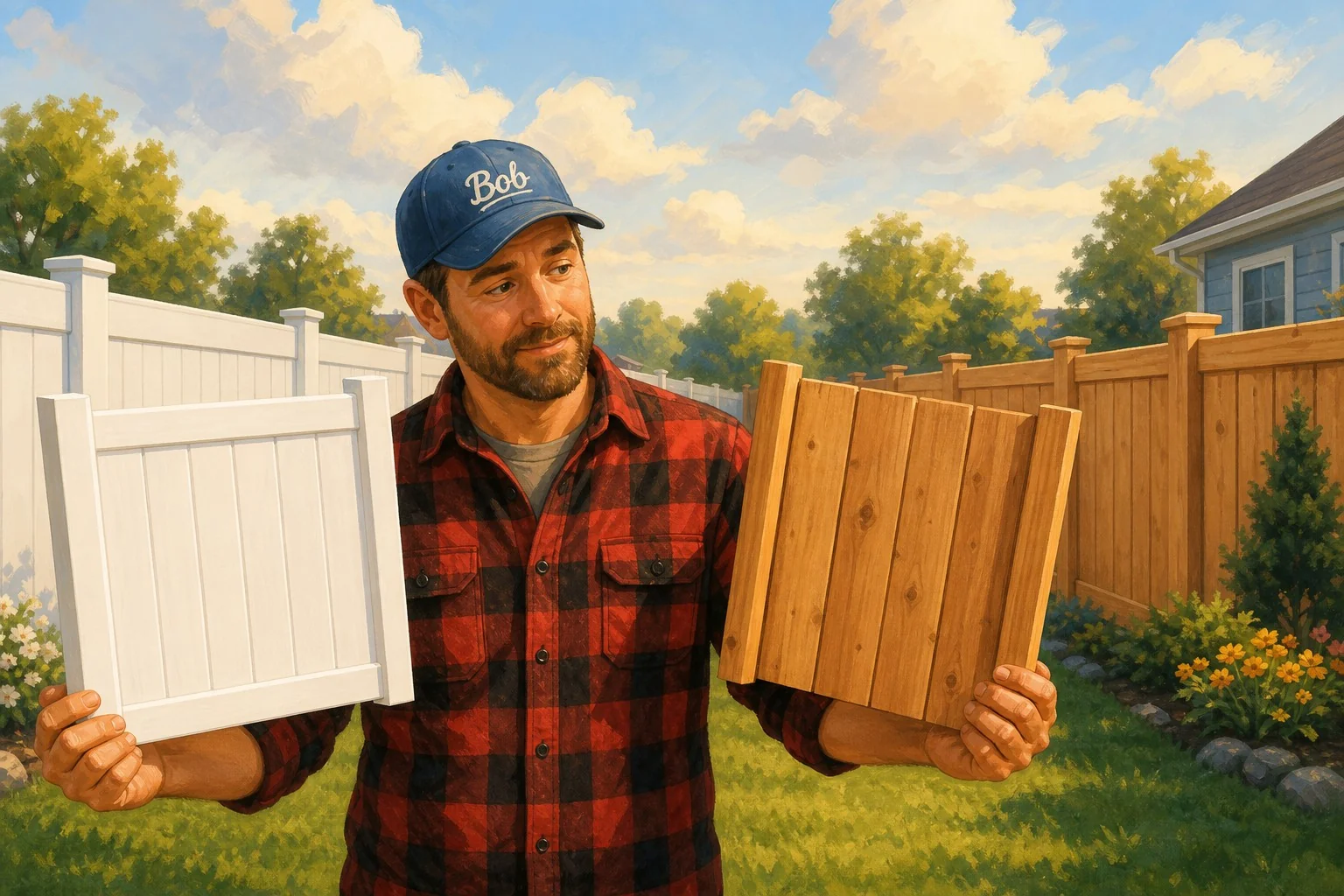
Short answer: wood is cheaper today. Vinyl is cheaper over twenty years. That’s the whole math in one sentence. The rest of this is why, and what to actually do about it.
People always want a single number. I get it — you’re trying to set a budget, the box store guy quoted you something, and now you’re standing in the yard wondering if you got hosed. So let me walk you through what actually drives the price difference, where homeowners get tripped up, and how to pick the right material for the way you actually live.
Upfront cost: wood wins, and it isn’t close
For a standard six-foot privacy fence — installed, not DIY — you’re roughly looking at:
- Pressure-treated pine: $20 to $35 per linear foot
- Cedar: $30 to $50 per linear foot
- Vinyl: $40 to $70 per linear foot
Fencing a quarter-acre lot is somewhere around 200 linear feet. That means vinyl will cost you $2,000 to $7,000 more on day one than pressure-treated pine. That’s real money. That’s a roof patch, a new dishwasher, and a weekend at the shore.
If you need this done by next Saturday and you don’t have a lot of cash sitting around, pressure-treated pine is your answer. Don’t overthink it.
Long-term cost: the part the box store doesn’t bring up
Here’s where wood starts losing the argument.
A wood fence needs:
- Staining or sealing every 2 to 3 years. Figure $300 to $800 each cycle if you hire it out. A weekend of your life if you don’t.
- Picket and rail replacement. Pine starts checking and warping in five to seven years. You’ll be replacing boards before year ten.
- Post replacement. This is the killer. When a post rots at the ground line — and it will — you’re not swapping a $15 four-by-four. You’re digging out concrete, resetting the post, and patching the panels you tore apart to get to it. Easily $200 to $400 per post when you pay someone.
Vinyl? You hose it off. That’s the maintenance.
I had a guy in Roxborough about twelve years back who “saved money” on a 180-foot pressure-treated fence. Looked great for four years. By year eight he’d already paid two stain crews and replaced about a dozen pickets. Year ten, three posts went on him after a wet winter. By the time I came out to quote a full replacement, he’d spent more on that “cheap” fence than the vinyl number he’d turned down a decade earlier. He didn’t want to hear it.
Lifespan reality check
- Pressure-treated pine, well maintained: 12 to 18 years
- Cedar, well maintained: 15 to 25 years
- Vinyl, basically ignored: 25 to 40 years
“Well maintained” is doing a lot of work in those numbers. Most people stain it once when it’s brand new and then never touch it again. If that’s you — and be honest — vinyl is cheaper for you. The math flips the second you stop doing the upkeep, and most people stop.
Three things to think about before you decide
1. How long are you staying in the house?
Selling in three to five years? Pressure-treated pine. Get the curb appeal, recover most of the cost in the sale price, move on. Staying for twenty-plus? Vinyl pays for itself, no question.
2. What’s your climate actually doing?
Vinyl gets brittle in deep cold and can crack if a kid runs into it on a January morning. In a Philly winter that’s a real concern. Wood handles temperature swings better but rots faster in wet years. Neither material is perfect — pick your poison based on what your weather actually does, not the brochure.
3. Can you do the repairs yourself?
Wood is forgiving. A picket pops off, you’ve got a hammer and four bucks at the lumberyard, you’re fixed in twenty minutes. Vinyl is proprietary — that panel from 2014 might not match what’s on the shelf in 2026. When vinyl breaks, you’re often paying a pro to source and swap a section. Factor that in before you decide.
Don’t forget the stuff between the materials
A couple costs people leave out of their mental math:
- Permits. Most townships want one. Budget $50 to $200 depending on where you live.
- Old fence removal and disposal. Tearing out a rotted wood fence isn’t free. $5 to $10 per linear foot if the contractor’s doing it.
- Grading and post-hole issues. Rocks, tree roots, old concrete buried from the last owner — all of that costs extra and applies to both materials.
Don’t get a quote and assume that’s the bottom line. Ask what’s in it and what’s not.
My take
If money on day one is the only question, go wood. If money over twenty years is the question, go vinyl. If you genuinely hate yard work and know yourself well enough to admit you’ll never stain a fence twice, go vinyl regardless of price — because most homeowners never keep up with wood, no matter what they swear to the installer in the driveway.
Don’t let anyone sell you on “lifetime” anything. There is no lifetime fence. There’s just how much you want to deal with it, and how much you want to pay to not deal with it.
Pick the one that fits how you actually live, not how you think you live.