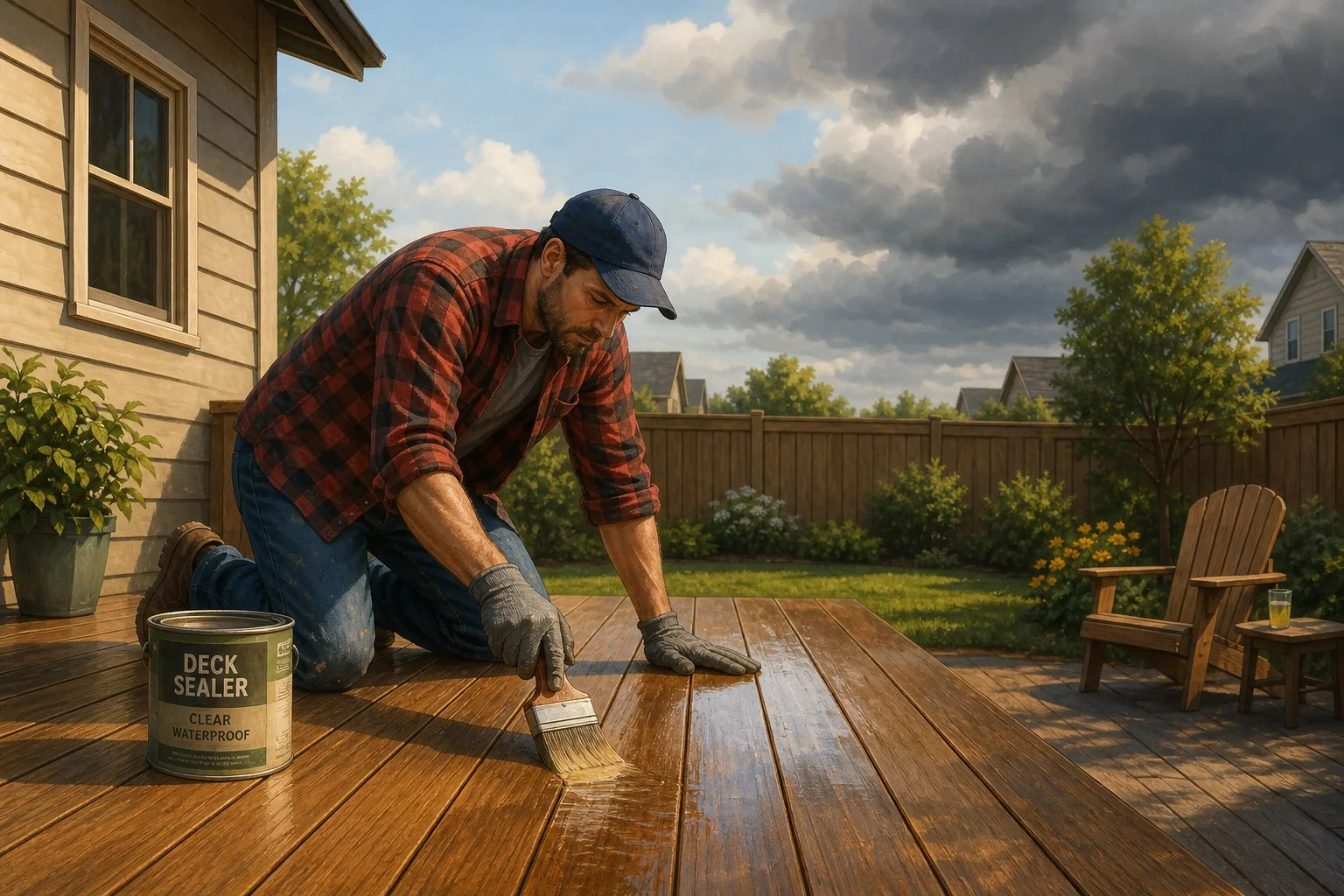
If you live anywhere between Scranton and the Delaware, you already know what July and August do around here. Big afternoon thunderstorms. Sideways rain. Humidity that never quits. Your deck is the first thing that eats it, and if you didn’t seal it up in the spring, you’re already behind. But you’ve still got time — barely.
Waterproofing a deck isn’t complicated. It’s just work. Homeowners screw it up because they either skip the prep, buy the wrong product, or pick the worst possible weekend to do it. Let’s fix all three.
First, find out if your deck actually needs sealing
Half the people I’ve talked to over the years are ready to slap sealer on a deck that doesn’t need it. The other half are hoping their bone-dry, gray, splintered planks will just hold on for one more summer. Neither one is doing themselves any favors.
Here’s the test. Take a cup of water and pour a little on a few different boards — near the house, out in the open, on the stairs. If the water beads up and sits there, your seal is still doing its job. Leave it alone. If it soaks in within a minute or two and darkens the wood, that deck is thirsty and you need to move.
You should also look for gray, fuzzy fibers on the surface. That’s UV damage plus moisture cycling. It means the top layer of wood is basically dead and needs to come off before anything else. Sealing over that is like painting over rot. It hides the problem for about three months, then it all comes back worse.
Match the product to the wood
This is where most homeowners get taken to the cleaners at the big box store. The 19-year-old kid in the orange apron doesn’t know what your deck is made of, and he’s not supposed to. You need to.
Pressure-treated pine. The most common deck material in Pennsylvania, and the pickiest about timing. If it’s brand new, wait. That stuff shows up wet from the mill and needs to dry for months before it’ll accept a sealer. If it’s older, an oil-based semi-transparent stain-and-seal combo is your best bet. It penetrates, colors, and protects in one shot.
Cedar and redwood. Softer. Prettier. More expensive to mess up. Use a clear or lightly tinted penetrating oil sealer with UV blockers. Film-forming products — the ones that leave a shiny coat on top — will peel on cedar within a year. Don’t do it.
Ipe, mahogany, and other tropical hardwoods. These are dense. Most sealers won’t soak in at all. You want a hardwood-specific oil, applied thin, wiped back with a rag. Two light coats beats one heavy coat every time on hardwoods. Try to flood these boards and you’ll end up with a sticky mess that never cures.
Composite decking. Not wood. Doesn’t get sealed. If somebody sold you sealer for a Trex deck, take it back.
The weekend timeline that actually works
I’ve watched more homeowners burn a Saturday because they tried to clean, dry, and seal in one day. Doesn’t work. Wood needs time. Here’s how to do it right.
Friday evening. Move the furniture off. Sweep. Look for popped nails or loose screws and fix them now. If you find a soft board, that’s a whole separate conversation, but at minimum flag it and plan to replace it. Don’t seal over a rotten board and pretend you didn’t see it.
Saturday morning. Clean the deck. A pump sprayer with a deck cleaner — the oxygenated stuff, not bleach — works better than a pressure washer for most homeowners. Pressure washers in the wrong hands turn a good deck into a fuzzy mess in about ten minutes. If you’re going to use one, keep the tip moving and stay 12 inches back. Rinse thoroughly. Let it dry all day Saturday and overnight.
Sunday morning. Check the forecast. You need 48 hours of no rain after you apply. If Sunday looks clean and Monday is dry, go. Apply your sealer with a stain pad or a good brush — rollers leave lap marks. Work two or three boards at a time, from one end of a board to the other, and don’t stop in the middle. Wipe up puddles in corners and around railings.
That’s it. Furniture goes back on Tuesday.
The one warning I actually mean
Do not seal a deck that’s damp. I don’t care what the label says about “damp wood” formulas. I had a guy in South Philly, nice rowhome with a rooftop deck, who sealed his boards the morning after an overnight drizzle. Two months later the whole thing was flaking off in sheets because moisture got trapped underneath. He paid me twice — once to strip it, once to redo it. Wait for dry wood. Every time.
Get this done before the last week of the month and you’ll be sitting on a deck that shrugs off the worst thunderstorm the mid-Atlantic can throw at it. Wait, and you’ll be reading this same article next spring while you shop for new boards.