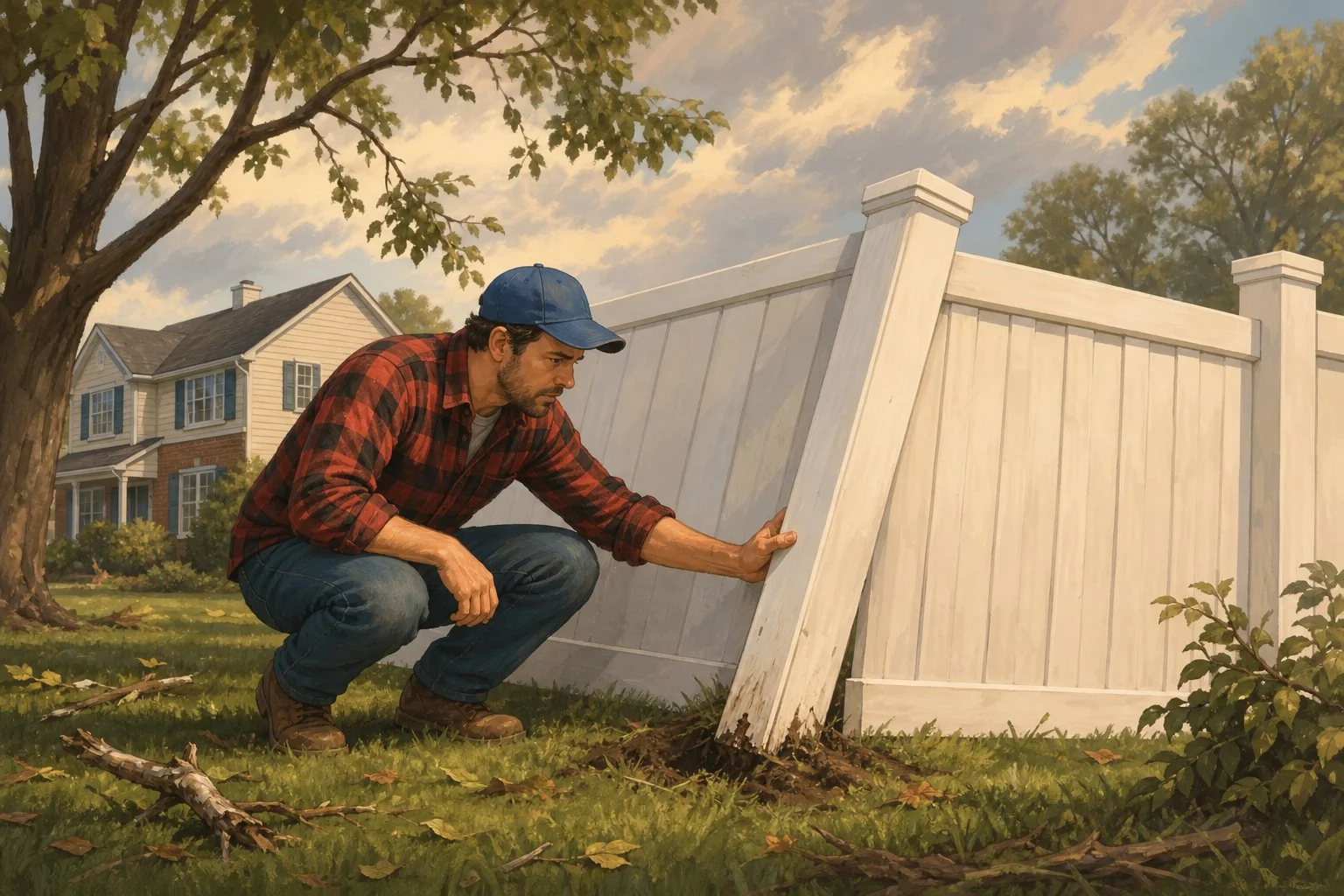
If you live in PA and your fence looks like it’s had a few too many at the corner bar, welcome to July. Every summer, thunderstorms roll through, the ground turns to soup, and homeowners from Doylestown to Delco start asking the same question: why is my fence leaning?
Short answer: the dirt holding it up gave up.
Longer answer takes a minute. Sit down.
Saturated soil is a fence post’s worst enemy
A lot of neighborhoods around here sit on thick clay. Clay holds water like a sponge. When you get three storms in a week — the kind where your basement drain starts making funny noises — that clay turns to pudding. A fence post buried in pudding doesn’t stand up straight, no matter how hard you cemented it in.
Then the wind hits. Even a moderate gust — 30, 40 mph — puts serious lateral pressure on a fence panel. Your six-foot privacy fence is basically a sail. That sail leans against a post rooted in soft mud, and the post tips. Sometimes just a hair. Sometimes it goes over like it’s had a stroke.
That’s the number one cause, and it doesn’t take a hurricane. A regular PA July does it.
What spring left behind
Here’s what a lot of people miss: your fence has been fighting for its life since March.
We get freeze-thaw cycles all winter in PA. Water gets in the ground around a post, freezes, expands, pushes the post up a fraction of an inch. Thaws. Refreezes. By April, that post has been lifted just enough that the concrete footing isn’t sitting where it used to. It’s loose in the hole. You couldn’t see it because the panel still looked straight.
Then July storms hit. Now the loose post has nothing holding it, and gravity finishes the job.
If you didn’t notice any lean in May or June, but your fence looks drunk in July — frost heave is probably part of it. The storm just revealed the damage.
What to actually check
Walk your fence line. Don’t just glance at it from the deck. Get up on it and check the following:
1. Post lean. Grab the post at the top and give it a firm push. If it wiggles more than about half an inch at ground level, the post is compromised. Wiggle at the top with nothing at the base means the panel hardware is loose, which is a different animal. Both matter.
2. Ground gap. Look at where the post meets the dirt. If you see a gap between the post and the soil — a little moat, basically — water’s been working on it. That post is loose in the hole and it’s going to keep leaning until you fix it or it falls.
3. Rot at the base. Stick a screwdriver into the wood at ground level. If it goes in like you’re stabbing a wet sponge, the post is done. Doesn’t matter how good the top half looks. The rot starts where the wood meets wet dirt, and it climbs.
4. Hardware. Check every bracket, screw, hinge, and lag bolt. Wind flexes a fence, and flexing loosens fasteners. Especially at gates. A gate hangs off two posts and a couple hinges — those hinges are almost always the first thing to fail after a big blow.
5. Concrete footing. If you can see the concrete footing at the base of the post, look for cracks. Water gets into a cracked footing and the whole thing crumbles from the inside out.
Repair or replace?
This is where I lose patience with the internet.
If a single post leaned and the wood is still solid — repair. Dig it out, reset it with fresh concrete, and if you do it right, that panel is fine. Cost of a bag of concrete and an afternoon.
If two or three posts along the same run are leaning, the wood at the base is soft, or the fence is more than 15 years old and you’ve been patching it every spring — replace the run. You’re throwing good money after bad. I had a homeowner up in Roxborough who kept resetting the same three posts every summer for four years. When we finally pulled them, the bases were oatmeal. He’d spent more on patch jobs than a new fence would’ve cost.
The rule of thumb: if the wood is compromised, replace. If it’s just the ground that failed, repair. Don’t cement a rotten post back into the hole and call it a win. You’re just delaying the funeral.
When to call somebody
Repair a single leaning post yourself if you’re handy. Digging, mixing concrete, plumbing a post — that’s a Saturday project, not brain surgery.
Call a pro if:
- More than three posts are leaning
- Any part of the fence is on a property line and you’re not 100% sure where the line is (survey first, or you’re paying for a fence twice)
- Gates are sagging or won’t latch
- You’re dealing with a fence taller than six feet
And if a post is leaning into a neighbor’s yard or over a public sidewalk, don’t wait. That’s a liability problem. A fence panel that comes down in the next storm and takes out a car or a kid is on you.
Bottom line
PA summer storms wreck fences because the soil can’t hold anymore, and half the time the damage started back in March. Walk your line. Check the posts, the hardware, the wood, and the ground. Fix what needs fixing before the next storm makes it worse.
A leaning fence doesn’t heal itself. Every day you wait, it leans a little more.