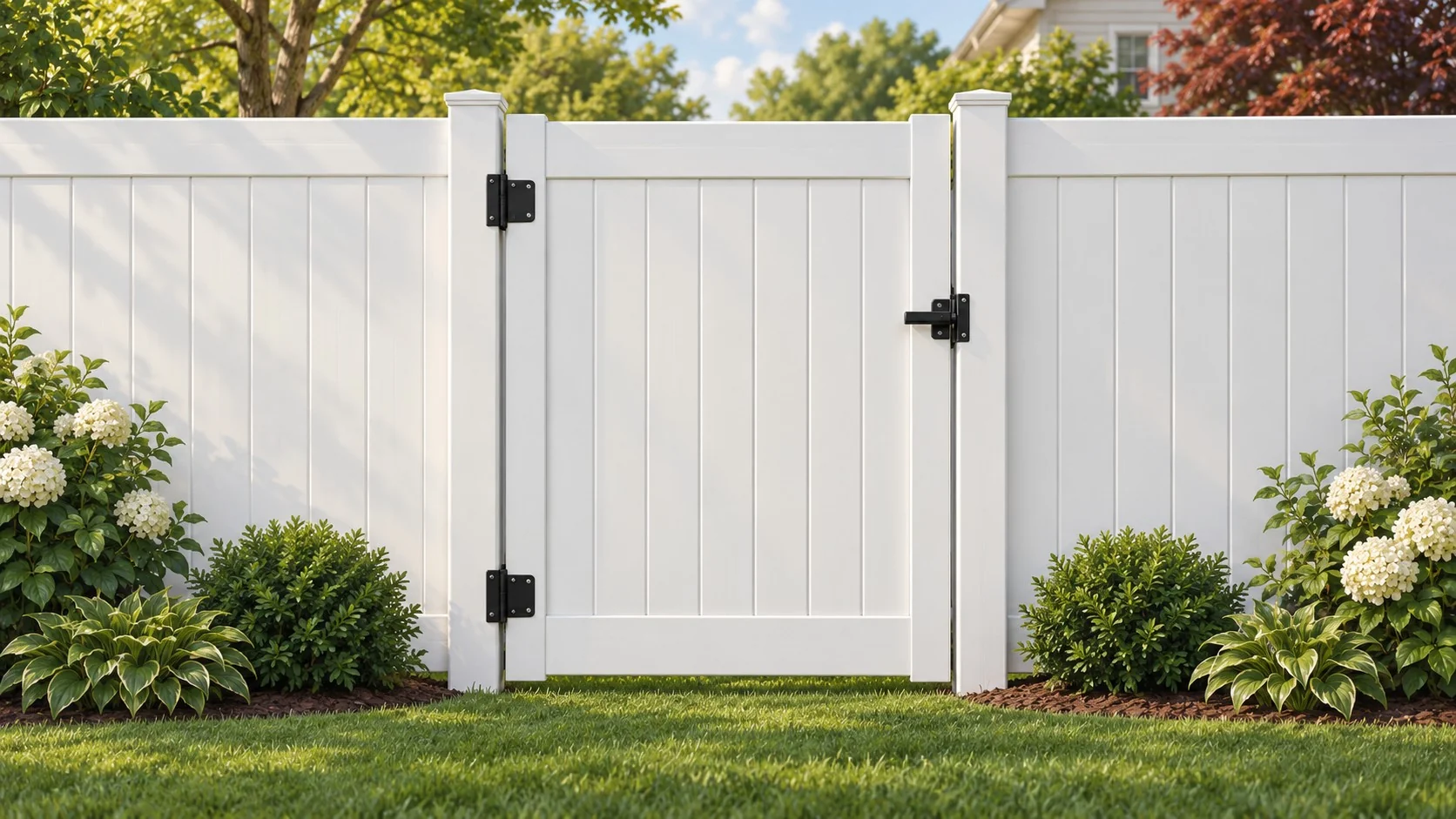
Vinyl gate hardware
A 4″×4″ gate upright beside a 5″×5″ fence post can look like a shortcut. The useful question is whether each part is doing the job it was designed to do.
The short answer
“Mike, the fence posts are five inches. These pieces on the gate are only four. Am I getting a cheaper gate?” Fair question. You are paying for a fence, you notice something different, and you want an explanation.
A gate upright is part of the moving gate. A fence post is part of the stationary support system. They have different jobs, and they do not need to be the same size.
Four-inch gate uprights are established, purpose-made components—not an improvised substitute for five-inch fence posts.
That difference deserves an explanation. It does not, by itself, deserve suspicion.
Open the Gate. The Difference Becomes Obvious.
Look at the vertical pieces beside a closed gate. They can look like a collection of posts wearing different-sized hats.
When it is closed
The hinge post stays put. The gate upright sits beside it, and the two profiles can look like neighboring versions of the same part.
When it opens
The gate upright swings away with the gate. On the other side, the latch-side upright moves too, while the latch post remains fixed.
The post holds up the gate. The upright helps hold the gate together.
A four-inch upright does not mean your installer substituted a smaller in-ground support post. That would be a different question entirely.
Why Use Five Inches for the Post and Four for the Gate?
The stationary post is part of the fence’s support structure. At a gate opening, its footing, reinforcement, and hardware connections must work together to support the hanging gate. Bufftech’s installation guide, for example, shows internal post stiffeners and separate requirements for the post foundation and hinge attachment. Hoover Fence Co.
The moving gate needs a frame assembled around its rails, infill, and hardware. Its upright is selected to fit that assembly.
Support post
Stays in the ground and receives the load from the hinges, footing, and surrounding fence.
Gate upright
Moves with the gate and provides the profile for the gate frame, pockets, hinges, and latch geometry.
Complete system
Works only when the post, insert, hardware, frame, and footing are specified together.
That means four inches is not a mysterious shortcut. It is a component size around which a gate system can be built. Gate pockets are sized for particular rail profiles. Those are gate-making details—not merely holes cut into whatever post was lying around the shop.
The practical design question is: What size and construction does this component need to do its job?
It is not: “What size is the piece standing next to it?”
There is nothing sacred about four inches, either. Another properly designed system may use a different profile. The dimensions must suit the system—not satisfy a rule that every vertical piece must match.
“But Wouldn’t Five-Inch Uprights Be Stronger?”
Possibly—in an otherwise comparable design. Bigger sections can offer structural advantages.
But that is not the same as saying the gate needs them.
The weak point may be somewhere else
When you add material to a moving gate, you add weight that the hinges and supporting post must carry. A larger upright might offer a useful benefit, or it might add bulk without addressing the actual weak point.
Imagine a gate with poorly connected corners. Making its vertical members wider does not automatically fix those connections. Likewise, a beautifully built gate cannot compensate for an inadequately supported hinge post.
You have to evaluate the assembly, not award the job to whichever piece looks fattest.
That is why I would ask about the frame construction and the hardware before demanding another inch of vinyl. Catalyst’s own gate specifications emphasize structural design and hinges selected to support the gate’s weight—not simply matching the upright dimensions to the surrounding posts. Catalyst™ Fence Solutions
“Will It Look Like the Wrong Gate?”
Matching does not have to mean identical in every measurement.
For a coordinated appearance, I would look at the color, finish, infill pattern, rail arrangement, and overall proportions. Catalyst, for example, offers matching gate options across its fence styles rather than treating the gate as an ordinary fence section with hinges attached. Catalyst™ Fence Solutions
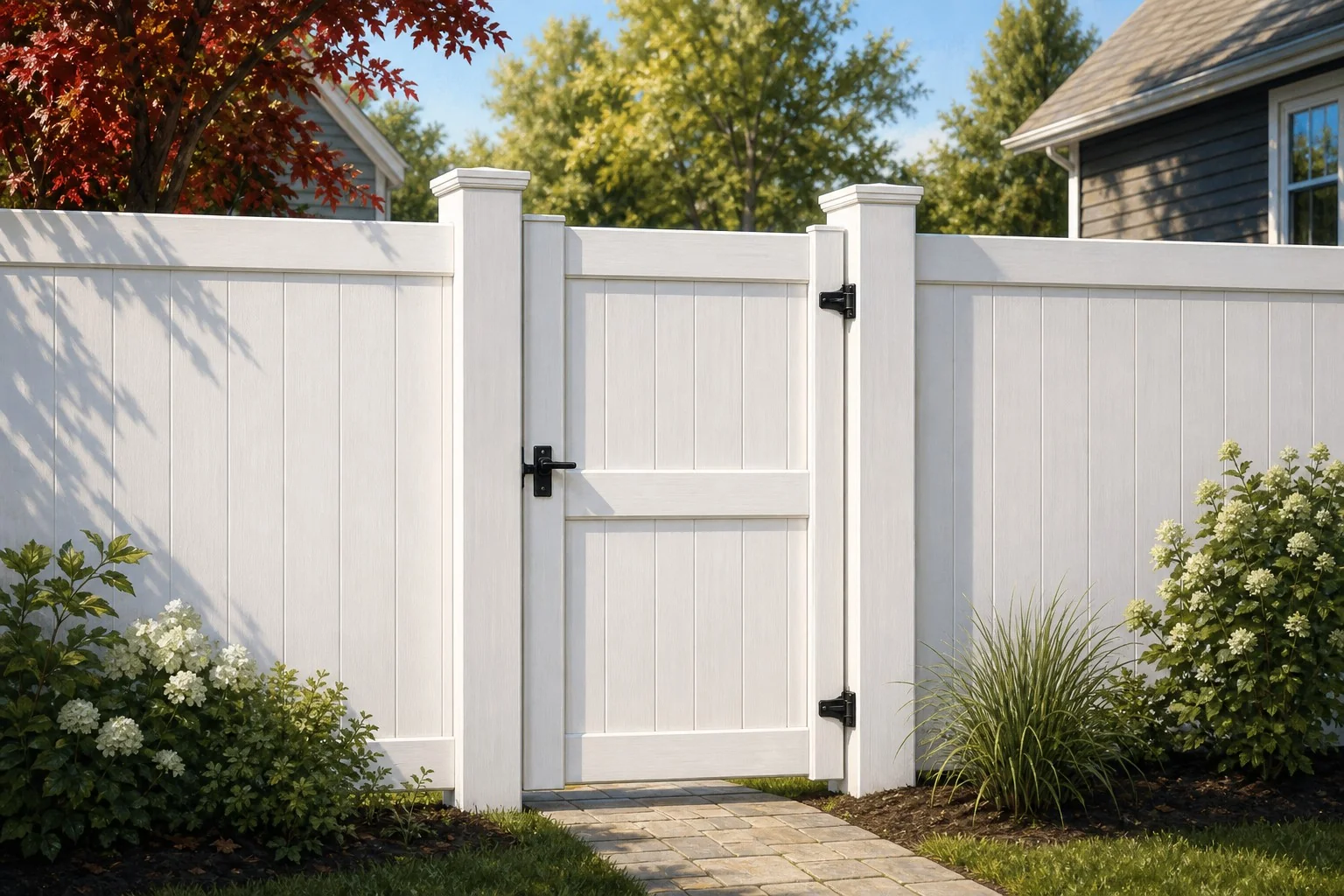
Picture the finished installation: substantial fixed posts defining the opening, a slightly slimmer frame around the moving gate, and coordinated panels between them.
That is a perfectly reasonable design composition—not automatically a mismatch.
The useful question is, “Is this the gate designed to go with this fence?” Not, “Does every square tube measure the same?”
What I Would Actually Check Before Signing Off
I would not wave away a customer’s concern with “That’s how everybody does it.” Show me the product details.
-
Confirm the specified components
The supplier should identify the gate system, upright profile, and applicable installation instructions. Manufacturers publish product-specific guides because the details differ. Catalyst™ Fence Solutions
-
Check how the gate stays square
Look for the specified reinforcement, sound rail-to-upright connections, and whatever bracing or frame design that particular gate requires. AVO’s construction description is a useful example of why those connections matter. Avofence and Supply
-
Check the installation
The supporting posts, hinge attachments, and operating clearances need to follow the system’s requirements. Bufftech’s guide addresses these separately; having the right upright size does not replace any of them. Hoover Fence Co.
Those are worthwhile things to question. I would rather answer all three than spend twenty minutes defending an outside measurement.
The Bottom Line
Use the gate system as a system
A 4″×4″ gate upright beside a 5″×5″ fence post is a normal, established arrangement. The smaller piece is not pretending to be the larger one. It belongs to a different assembly and performs a different job.