How to Keep Your Wood Deck Looking Great Through Pennsylvania’s Humid Summer
Pennsylvania summers are brutal on wood. You get the June rains, then July and August hit like a wet blanket — 85 degrees, 80 percent humidity, sun beating down between the storms. Your deck takes all of it. If you don’t get ahead of it now, by Labor Day you’ve got mildew streaks, gray boards, and your wife is asking why the railing feels furry.
I’m going to tell you what actually works. Not the stuff you read on the back of a can at Home Depot.
Step One: Clean It Right, Not Hard
Every spring I see homeowners drag out a 3,000 PSI pressure washer and absolutely destroy their decks. They strip off the finish, tear up the wood fibers, and then wonder why the boards turn gray and rough by July. Don’t do that.
Use a stiff-bristle brush and a deck cleaner — oxygenated stuff, not bleach. Sodium percarbonate is what you want. It lifts dirt and kills surface mildew without bleaching the wood pale or burning out the boxwoods you planted next to the deck. Mix it up, slop it on, let it sit fifteen minutes, scrub it with the grain, then rinse with a garden hose. That’s the whole job.
If you absolutely have to use a pressure washer, dial it down to 1,200 to 1,500 PSI, put a wide fan tip on it, and keep the wand at least a foot off the wood. Move with the grain. The second you stop moving in one spot, you’re carving grooves into the board.
Step Two: Handle the Mildew Before It Eats the Deck
The minute humidity climbs in PA, mildew shows up. Those black streaks running along the boards? That’s it. It loves shaded sections, north-facing parts of the deck, anywhere airflow is poor.
I had a job out in Ardmore a few years back — couple bought a beautiful house with a wraparound deck tucked under a big oak tree. They’d ignored it for three summers. By the time they called me, the mildew had worked into the boards so deep we ended up replacing about forty percent of the decking. Cost them around six grand they didn’t need to spend if they’d cleaned it twice a year.
Hit it early. The oxygenated cleaner handles most surface mildew. For stubborn black spots, you can spot-treat with a deck-safe mildewcide — read the label, follow the dilution, wear gloves. Don’t get clever and mix your own chemistry. People do this and either hurt themselves or kill the wood.
While you’re at it, trim back any vegetation that’s touching the deck or hanging over it. Airflow is your best friend in a PA summer. A deck that can breathe dries out between storms. A deck buried under hostas and overhanging branches stays wet for days, and wet wood rots.
Step Three: Seal It — At the Right Time
Here’s where most homeowners screw up. They wait until mid-July, pick a beautiful sunny afternoon when it’s 90 degrees, and slap sealer on a hot deck. The sealer flashes off before it penetrates, sits on top tacky, and you’re scraping it back off in October.
Seal early summer or wait until September. Pick a stretch of two to three days with no rain in the forecast, temps in the 60s or low 70s, humidity on the lower end if you can find it in PA — good luck. The wood needs to be dry. Dry-dry. After a cleaning, give it 48 hours minimum, longer if it stays muggy.
Use a penetrating oil-based sealer or a quality semi-transparent stain. Skip the film-forming products — the solid stains and the thick “deck resurfacer” stuff. They look great for one season and then peel like a sunburn. Once they peel, you’re sanding the whole deck back to bare wood to fix it. It’s not worth the headache.
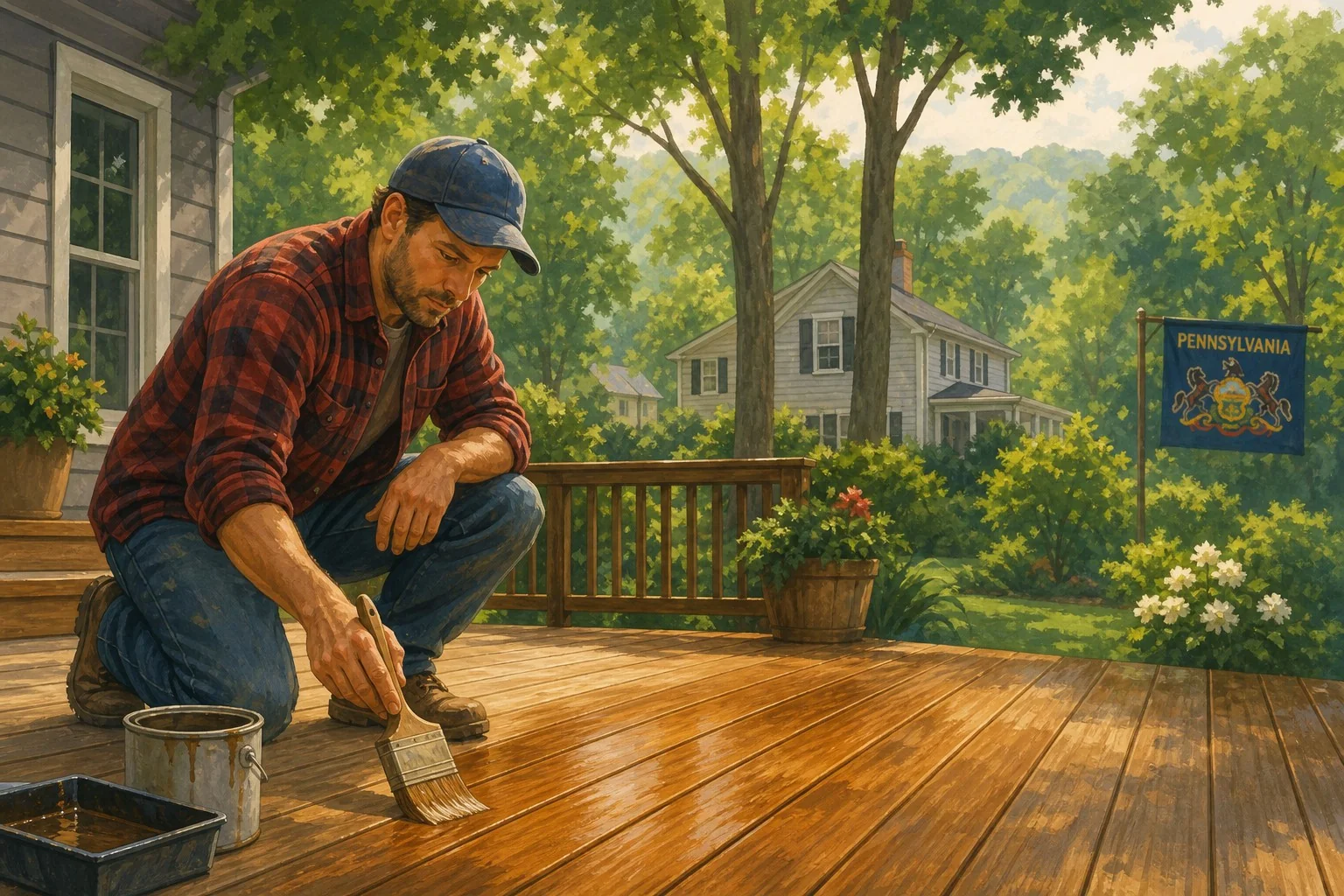
Apply with a pad applicator or a good brush. Two thin coats beats one thick coat every time. Let it dry between coats per the can. Don’t walk on it in your work boots an hour later because you’re impatient.
Step Four: The Quick Stuff Most People Skip
Walk the deck before the first big party. Take a Phillips head screwdriver and poke around the joists, the ledger board where the deck meets the house, and any spot that stays wet — corners, around posts, under planters. If the screwdriver sinks in, you’ve got rot. That’s a bigger conversation. Get a contractor out.
Tighten loose deck screws and replace any popped nails with screws. Sweep the gaps between boards — leaves and debris trap moisture, and that’s where rot starts. Check your railings by leaning into them like a guest will after three beers. If they wiggle, fix them now, not after someone goes over the side.
The Bottom Line
A wood deck in PA needs attention twice a year — once in spring to clean and seal, once in fall to clean and clear debris. Skip it and you’re looking at a full replacement in eight to ten years. Stay on it and you’ll get twenty-five years out of pressure-treated lumber, longer out of cedar or a hardwood.
It’s not complicated. It’s just work. Do it now, before the worst of the heat sets in, and your deck will look sharp all summer instead of looking like the back of an abandoned property by August.