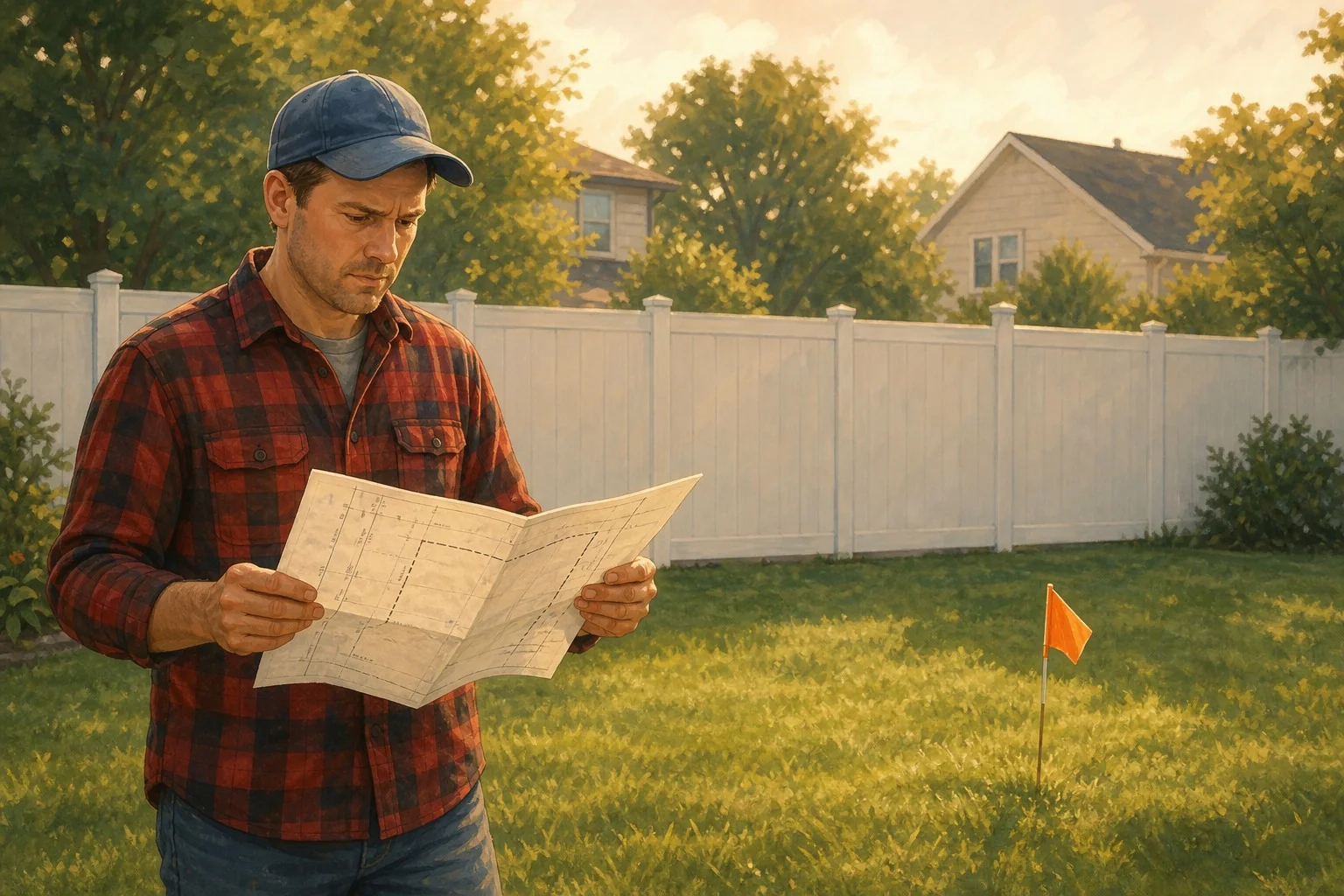
You just got your property surveyed. Maybe you were thinking about putting up a shed, or refinancing, or listing the house. The surveyor drives his stakes in the ground, hands you a stamped drawing, and now you’re standing in your yard staring at your neighbor’s fence — which is sitting three feet inside what the survey says is yours.
Welcome to one of the most annoying problems in homeownership.
I’ve seen this play out plenty of times. Sometimes it’s a fence. Sometimes it’s a driveway, a shed, a hedge that’s been there since Nixon was in the White House. The result is the same. Somebody else’s stuff is on your dirt, and now you’ve got to figure out what to do about it.
Short answer: don’t panic, don’t touch the fence, don’t call a lawyer yet. Do these things in order.
First, make sure your survey is actually right
The paper you got at closing isn’t a survey. I need to say that plainly because a lot of homeowners think it is. It’s a plot plan or a mortgage location certificate — a rough sketch drawn from public records so the bank can push your loan through. It is not a legal boundary determination.
A real survey is done by a licensed land surveyor who physically comes out, finds the corner monuments — or sets new ones — and issues a stamped drawing. That’s what you want. Costs somewhere between $500 and $2,000 depending on your lot size and how much brush he has to hack through to find the pins.
Before you go pointing fingers at the neighbor, be sure your own paperwork is solid. I had a client in Fishtown ready to rip out a neighbor’s retaining wall over eighteen inches. We pulled a fresh survey and it turned out his own back fence was three feet over the line on the other side. He’d been sitting on somebody else’s land for twenty years without knowing it. He shut up real quick after that. Everybody was wrong. Nobody knew.
Then, talk to the neighbor before you lawyer up
I know. Not what you wanted to hear. But this is real advice.
Nine times out of ten, your neighbor has no idea the fence is over the line. The guy before him put it up. He inherited the mess. He’s not sitting over there scheming to steal your yard.
Walk over. Bring the survey. Show them, don’t tell them. Something like, “Hey, I had this survey done, I don’t know how we want to handle it, but I wanted you to see it.” Keep it calm. Keep it factual. Give them a chance to be a reasonable human being. Most people are, when they’re not cornered.
Once you drag an attorney into it, the relationship is done, whatever happens next. Your kids and their kids are going to grow up hearing about the property line every Fourth of July. Try the human route first.
Understand the adverse possession clock
Now here’s where people get scared, and they should — a little.
Adverse possession is the legal rule that says if somebody uses part of your property openly, continuously, and without your permission for long enough, they can eventually claim it as theirs. In Pennsylvania that’s 21 years. Other states range from about 5 to 30 depending on where you live. Check yours before you assume anything.
If a fence has been sitting on your side of the line for two decades and neither owner ever objected, the neighbor may actually have a legal argument to that strip. It’s not automatic. They’d have to prove it in court. But the clock matters.
This is why you don’t sit on it. If you know there’s an encroachment and you plan to do nothing about it for a while, at least document that you objected. A written notice — “I am aware your fence is on my property, I do not consent to it being there” — kills the adverse possession claim in most states. Send it certified mail. Keep the green card.
Know your resolution options
Once you and the neighbor look at the survey together and confirm the encroachment is real, you basically have four ways to go:
- Move the fence. They tear it down and rebuild it on the correct line. Cleanest option if the encroachment is small and both parties are willing. Sometimes you kick in some cash to make it painless.
- Sell them the strip. If they’ve been using that three feet forever and it doesn’t hurt you, sell it. A boundary line adjustment, done with a real estate attorney and a new deed recorded at the courthouse, is cheaper than most people think. A few hundred in legal work plus filing fees.
- Boundary line agreement. You both sign a document saying, “This is the line, we agree, done.” Then you record it at the county. Common when the exact old line is fuzzy and nobody wants to fight about it.
- Grant an easement. They keep the fence where it is, but the land is still legally yours. Useful if you don’t want to sell but you also don’t want to force them to move it. Also gets recorded.
Whatever you choose, get it in writing and get it recorded at the county recorder of deeds. A handshake between neighbors means nothing when one of you sells the house and a stranger moves in.
When you actually need a lawyer
If the neighbor gets nasty. If there’s real money involved — an addition or garage over the line, not just a fence. If adverse possession is being claimed against you. If the survey itself is being disputed by another survey. Those are the times to spend the money on a real estate attorney who does boundary work.
For a shed that’s eighteen inches over? Buy a bottle of something decent, walk over, and have the conversation. That will save you three grand and a lot of grief.
Bottom line
A survey doesn’t fix anything. It tells you where the line is. What you do about it is on you — and how you handle the first conversation with the neighbor is going to decide whether this is a two-week problem or a two-year problem. Pick your approach carefully. Whatever you agree to, put it on paper, and get it recorded down at the courthouse. That’s the part most people skip, and it’s the part that actually protects you.